
Belonocnema kinseyi
Weld, 1921
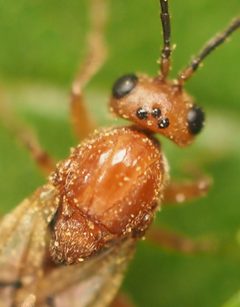
Belonocnema kinseyi is a gall wasp in the Cynipidae that induces galls on live oaks (Quercus virginiana and Quercus fusiformis). It exhibits an alternating with distinct sexual and that form different gall types on different plant parts. The species was first described in 1921 by Lewis Hart Weld, synonymized with B. treatae in 1998, and re-elevated to species status in 2021 based on genetic and morphological evidence. It has become a model organism for studying speciation and gall wasp .
Pronunciation
How to pronounce Belonocnema kinseyi: /bɛloʊˈnɒknɪmə ˈkɪnsaɪaɪ/
These audio files are automatically generated. While they are not always 100% accurate, they are a good starting point.
Identification
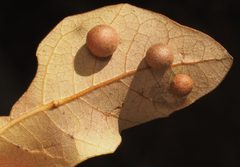
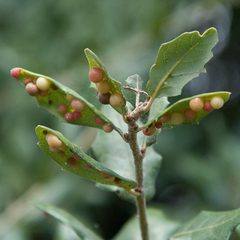
Distinguished from Belonocnema fossoria by the shorter spur on the fore tibia relative to the basitarsus and tibial spur in both . Separated from B. treatae in the sexual generation by deeply delimited scutellar foveae narrowly separated by a carina, reddish brown coloration, and in the generation by an indistinctive areolet. The asexual generation forms smooth, unilocular, spherical leaf galls, while the sexual generation forms irregular, multilocular root galls.
Images
Habitat
Live oak forests and woodlands; specifically associated with Quercus virginiana and Quercus fusiformis in the southern United States.
Distribution
United States: southern Louisiana, southern Mississippi, a small area of Oklahoma, and south, central, and southeast Texas. Distribution follows that of its trees, with a turnover zone in southeast Mississippi where B. treatae replaces B. kinseyi for the remaining eastern range of Q. virginiana.
Host Associations
- Quercus virginiana - live oak; forms galls on leaf undersides, sexual generation forms galls on roots
- Quercus fusiformis - live oak; forms galls on leaf undersides, sexual generation forms galls on roots
Life Cycle
Alternating sexual and (heterogony). Asexual generation: females reproduce parthenogenetically, forming smooth, unilocular, spherical galls on the side of leaves; galls are orange or light brown when young and darken with age. Sexual generation: males and females reproduce sexually, forming irregular, multilocular clusters of galls on small rootlets. The two generations were historically confused, leading to taxonomic synonymy until 2021.
Behavior
Induces gall formation on oaks through chemical manipulation of plant tissue, creating protected chambers for larval development. activity patterns have been studied as part of ecological research on this .
Ecological Role
Gall-former that induces structural changes in oak tissues, creating microhabitats for larval development. The galls support associated of hymenopteran and ; a 2022 study on a related noted 43 morphospecies of associated hymenopterans across 15 and 13 .
Human Relevance
Used as a model organism for studying speciation, ecological , and the evolution of in gall wasps. The was named in honor of Alfred Kinsey, the prominent entomologist and sexologist who contributed extensively to knowledge of North American gall wasps.
Similar Taxa
- Belonocnema treataeOverlapping geographic range and use; distinguished by less deeply delimited scutellar foveae in sexual , different coloration, and distinctive areolet in generation. Historically synonymized with B. kinseyi due to confusion about gall locations.
- Belonocnema fossoriaSimilar and association; distinguished by longer spur on fore tibia relative to basitarsus and tibial spur in both .
- Belonocnema mesoamericanaSister with similar ; distinguished by color and features, and by sexual forming velvety rootlet galls rather than irregular multilocular clusters. Found on Quercus oleoides in Mesoamerica rather than southeastern USA.
Misconceptions
The was incorrectly synonymized with B. treatae from 1998 to 2021 because the sexual root galls were believed to be exclusive to B. treatae. Genetic and morphological analysis in 2021 demonstrated that B. kinseyi is a distinct species with its own sexual generation forming root galls.
More Details
Taxonomic History
First described by Lewis Hart Weld in 1921 from leaf galls on Quercus fusiformis in Boerne, Texas. The specific epithet honors Alfred Kinsey. Synonymized with B. treatae in 1998 when sexual root galls were discovered, then re-elevated to status in 2021 through integrative systematic analysis using morphological characters, records, museum specimens, propensity, and phylogenetic analysis of COI and nuclear SNP data.
Phylogenetic Position
Genetic data places B. kinseyi as an outgroup to a clade containing its sister B. treatae and B. fossoria. A 2022 study using multilocus data from Ultraconserved Elements placed it as sister to Druon quercuslanigerum within Cynipidae.
Molecular Identification Challenges
Mitochondrial (COI) fails to distinguish B. fossoria from B. treatae due to mitonuclear discordance, but does recognize B. kinseyi. However, all three are clearly separable using and nuclear SNP data.
Sources and further reading
- BugGuide
- Wikipedia
- GBIF taxonomy match
- iNaturalist taxon
- NCBI Taxonomy
- One hundred and sixty years of taxonomic confusion resolved:Belonocnema(Hymenoptera: Cynipidae: Cynipini) gall wasps associated with live oaks in the USA
- Integrative systematics of a new species of the gall wasp genus Belonocnema Mayr (Cynipidae, Cynipini) on the Mesoamerican live oak Quercus oleoides (Fagaceae) and its associated hymenopteran community