
Mellinus rufinodus
Cresson, 1865
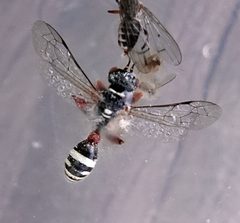
Mellinus rufinodus is a small predatory in the Crabronidae, first described by Cresson in 1865. The occurs in Central America and North America, though specific biological details remain poorly documented. Like other members of the Mellinus, it is presumed to be a solitary hunter of flies, but direct observations of this particular species are scarce.
Pronunciation
How to pronounce Mellinus rufinodus: //mɛˈlɪnəs ruːˈfaɪnoʊdəs//
These audio files are automatically generated. While they are not always 100% accurate, they are a good starting point.
Identification
Mellinus rufinodus can be distinguished from similar small predatory by its (stalked) , a trait not shared by other fly-predating wasps of comparable size (8–10 mm). Within the Mellinus, -level identification requires examination of specific morphological characters; M. rufinodus may be separated from the better-known M. arvensis and M. bipunctatus by geographic distribution and subtle structural differences, though precise diagnostic features for this species are not well established in published sources.
Images
Distribution
Central America and North America. GBIF records indicate presence in Middle America and North America.
Similar Taxa
- Mellinus arvensisEuropean with well-documented ; M. rufinodus occurs in the Americas and lacks comparable behavioral documentation.
- Mellinus bipunctatusNorth American with similar size and ; distinguished by specific structural characters and potentially overlapping range.
- Crabronini tribe waspsSimilar small size and fly-hunting , but lack the characteristic of Mellinus.
More Details
Taxonomic Note
The Mellinus was historically placed in Mellinidae, but modern classifications (including GBIF and Catalogue of Life) assign it to Crabronidae, Mellininae.
Data Deficiency
Most biological information attributed to Mellinus derives from observations of the European M. arvensis. Direct study of M. rufinodus is limited; iNaturalist records only 18 observations as of source date.