
Alysson oppositus
Say, 1837
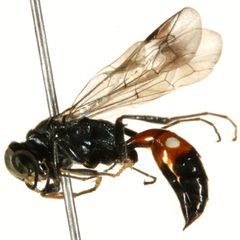
Alysson oppositus is a of digger wasp in the Crabronidae (formerly Bembicidae). It is native to North America, with records from Canada and the United States. The species was first described by Thomas Say in 1837. Like other members of the Alysson, it is a solitary that provisions nests with prey for its larvae.
Pronunciation
How to pronounce Alysson oppositus: /əˈlɪsən ɒˈpɒsɪtəs/
These audio files are automatically generated. While they are not always 100% accurate, they are a good starting point.
Identification
Alysson oppositus can be distinguished from by specific morphological features, though detailed diagnostic characters require specimen examination. The Alysson is characterized by a pronotum that is short and does not reach the tegulae, and a distinctively shaped . -level identification within Alysson typically requires examination of male genitalia and other subtle structural features.
Images
Distribution
North America; recorded from Canada (including Manitoba) and the United States.
Similar Taxa
- Alysson conicusAnother North American in the same , differing in structural details of the and genitalia
- Alysson melleusSympatric with similar overall appearance, requiring careful examination for separation
- Alysson striatusRelated with overlapping range, distinguished by subtle morphological differences
More Details
Taxonomic History
Alysson oppositus was originally described by Thomas Say in 1837. The -level classification has been revised; this was formerly placed in Bembicidae (or Nyssonidae in older literature) but is now classified in Crabronidae based on phylogenetic studies.
Collection Records
The is represented in museum collections, including holdings at the UCR Entomology Research Museum.