
Hylaeus schwarzii
(Cockerell, 1896)
Schwarz's Masked Bee
Hylaeus schwarzii is a of masked in the Colletidae, native to North America. Like other members of the Hylaeus, it is a solitary, nearly hairless bee that superficially resembles small . The species was described by Cockerell in 1896 and is one of approximately 50 Hylaeus species occurring in North America. Very little species-specific information is documented for H. schwarzii; most knowledge of its is inferred from the broader genus.
Pronunciation
How to pronounce Hylaeus schwarzii: /hɪˈliːəs ˈʃvarts.i.aɪ/
These audio files are automatically generated. While they are not always 100% accurate, they are a good starting point.
Identification
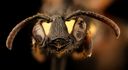
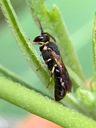
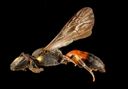
Hylaeus schwarzii is a small, nearly hairless with reduced that creates a -like appearance. Females typically display pale or yellowish markings on the inner margins of the , while males have more extensive yellow or white coloration across the entire —the characteristic "masked" pattern for which the is named. Definitive -level identification requires examination of microscopic morphological characters and is best confirmed by a taxonomist. The bee lacks the dense, branched () hairs typical of most bees; at 60× magnification or higher, this hair type distinguishes Hylaeus from similarly hairless wasps.
Images
Distribution
North America. Specific range details within this region are not well documented in available sources.
Ecological Role
As a member of the Hylaeus, H. schwarzii likely functions as a , though this has not been confirmed at the level. The genus as a whole contributes to pollination of various flowering plants, with some species showing preference for particular plant when available.
Similar Taxa
- Hylaeus modestusAnother small North American masked with similar -like appearance and facial markings; requires microscopic examination to distinguish
- Other Hylaeus speciesApproximately 50 occur in North America, many sharing the characteristic reduced hair and facial mask pattern; species boundaries are subtle and require identification
- Small sphecid wasps (e.g., Crabronidae)Superficially similar in size, coloration, and hairlessness; distinguished by hairs in bees (visible at 60× magnification) and by behavioral differences
Sources and further reading
- BugGuide
- Wikipedia
- GBIF taxonomy match
- iNaturalist taxon
- Catalogue of Life
- Looking for Cheap Urban Real Estate | Bug Squad
- Bug Eric: Wasp Wednesday: Not Wasp VI
- Bug Eric: A Beautiful Place to "Bee"
- Some Varieties of Annual Flowers Have a Place in Pollinator-Friendly Gardens
- Bug Eric: Wasp Wednesday: Anacrabro ocellatus
- National Meadows Day 2022 in Northern Ireland - Buglife Blog - Buglife