
Hylaeus polifolii
(Cockerell, 1901)
Buckwheat Masked Bee
Hylaeus polifolii is a solitary in the Colletidae, commonly known as the buckwheat masked bee. It is native to North America and belongs to the Hylaeus, a group of nearly hairless bees often mistaken for due to their slender appearance. The species has two recognized : H. p. catalinensis and H. p. polifolii. Like other masked bees, females transport pollen and nectar internally in a crop rather than on body hairs.
Pronunciation
How to pronounce Hylaeus polifolii: /hɪˈliːəs ˌpɒlɪˈfoʊli.aɪ/
These audio files are automatically generated. While they are not always 100% accurate, they are a good starting point.
Identification
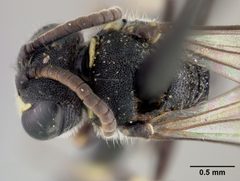
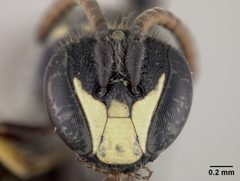
Hylaeus polifolii can be distinguished from similar Hylaeus by examining facial markings: females have pale markings on the inner margins of the , while males have the entire colored pale yellow or white. As with all Hylaeus, the body is nearly hairless with a slender, -like build. Definitive identification to species level typically requires examination by a taxonomist, as external characters can be subtle.
Images
Distribution
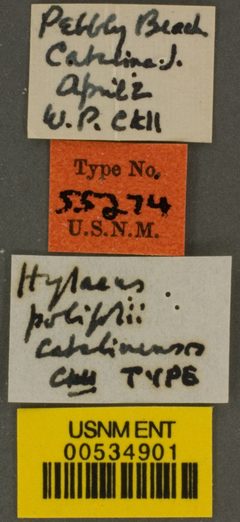
Found in North America. The H. p. catalinensis occurs on Santa Catalina Island, California, while the nominate subspecies H. p. polifolii has a broader distribution on the mainland.
Ecological Role
As a member of the Hylaeus, this likely functions as a . Females collect pollen and nectar from flowers to provision nest , contributing to plant in its native range.
Similar Taxa
- Hylaeus modestusBoth are North American masked bees with similar nearly hairless, -like appearance; distinguished by facial marking patterns and geographic distribution.
- Hylaeus bisinuatusAnother western North American Hylaeus with similar ; H. bisinuatus has been documented as a pollen on White Sweetclover.
Sources and further reading
- BugGuide
- Wikipedia
- GBIF taxonomy match
- iNaturalist taxon
- Catalogue of Life
- Looking for Cheap Urban Real Estate | Bug Squad
- Bug Eric: Wasp Wednesday: Not Wasp VI
- Bug Eric: A Beautiful Place to "Bee"
- Some Varieties of Annual Flowers Have a Place in Pollinator-Friendly Gardens
- Bug Eric: Wasp Wednesday: Anacrabro ocellatus
- National Meadows Day 2022 in Northern Ireland - Buglife Blog - Buglife