
Hylaeus ornatus
Mitchell, 1951
Ornate Masked Bee
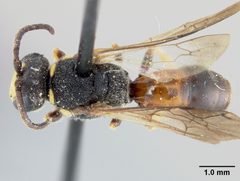
Hylaeus ornatus, commonly known as the masked , is a of solitary bee in the Colletidae. It is native to North America and belongs to the Hylaeus, commonly called masked bees or yellow-faced bees due to their distinctive pale facial markings. Like other members of its genus, it is nearly hairless and carries pollen internally rather than on body hairs.
Pronunciation
How to pronounce Hylaeus ornatus: /haɪˈliːəs ɔːrˈneɪtəs/
These audio files are automatically generated. While they are not always 100% accurate, they are a good starting point.
Identification
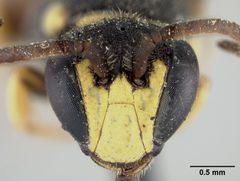
Hylaeus ornatus can be distinguished from other Hylaeus by specific facial marking patterns and body proportions, though precise diagnostic features require examination. Males typically have the entire colored yellow or white, while females show yellow, white, or ivory markings on the inner margin of each . The species is nearly hairless, giving it a -like appearance. Definitive identification from images alone is difficult and may require examination by a taxonomist.
Images
Distribution
North America. Specific records indicate presence in the United States, though precise range boundaries within North America are not well documented in available sources.
Life Cycle
As a member of the Hylaeus, Hylaeus ornatus likely follows the general pattern of masked bees: solitary nesting in pre-existing cavities such as hollow stems, twigs, or abandoned insect burrows. Females construct individual lined with a glandular secretion that forms a natural polymer (cellophane-like material) to store pollen and nectar. Larvae develop within these cells. However, specific details for H. ornatus have not been documented in available sources.
Behavior
Like other Hylaeus , females are expected to be solitary nesters that transport pollen and nectar internally in a specialized crop, regurgitating food stores at the nest. Males may congregate near nesting areas. The species has been observed visiting flowers, though specific foraging are not documented.
Ecological Role
As a , Hylaeus ornatus contributes to plant through flower visitation. The degree of specialization or generalization in its pollen foraging habits is unknown for this specifically.
Similar Taxa
- Hylaeus modestusAnother North American masked of similar size and general appearance; both are nearly hairless with yellow facial markings. Distinguishing between species requires examination of specific facial marking patterns and subtle morphological differences.
- Other Hylaeus speciesMany Hylaeus share the characteristic nearly hairless, -like appearance and yellow or white facial markings. Species-level identification within the often requires knowledge and close examination of diagnostic characters not visible in field conditions.
- Small wasps (e.g., Crabronidae)Masked bees are frequently mistaken for small due to their sparse hair and similar body shape. Wasps have simple, unbranched hairs (visible at 60x magnification or higher), while bees have , feather-like hairs. Behavioral cues such as pollen collection and nest construction can help distinguish them.
More Details
Taxonomic Note
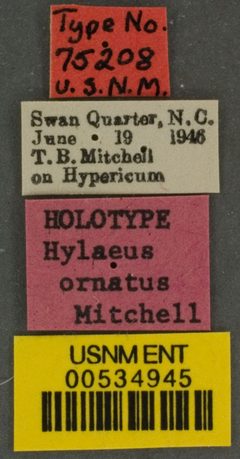
Hylaeus ornatus was described by Mitchell in 1951. The Hylaeus contains approximately 900 worldwide, with about 50 species in North America. The genus reaches its highest diversity in subtropical Australia and the Hawaiian Islands.
Conservation Context
While specific conservation status for H. ornatus is not documented, several Hylaeus in Hawaii are critically imperiled or possibly extinct due to . This highlights the vulnerability of masked species to disturbance and .
Data Limitations
Available sources provide minimal -specific information for Hylaeus ornatus. Most documented information about the species is inferred from -level characteristics or based on general knowledge of the Colletidae. Direct observation records and detailed biological studies for this specific species appear sparse in the accessible literature.
Sources and further reading
- BugGuide
- Wikipedia
- GBIF taxonomy match
- iNaturalist taxon
- NCBI Taxonomy
- Catalogue of Life
- Looking for Cheap Urban Real Estate | Bug Squad
- Bug Eric: Wasp Wednesday: Not Wasp VI
- Bug Eric: A Beautiful Place to "Bee"
- Some Varieties of Annual Flowers Have a Place in Pollinator-Friendly Gardens
- Bug Eric: Wasp Wednesday: Anacrabro ocellatus
- National Meadows Day 2022 in Northern Ireland - Buglife Blog - Buglife