
Hylaeus affinis
(Smith, 1853)
eastern masked bee
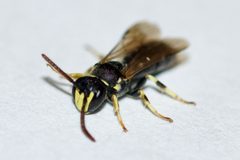
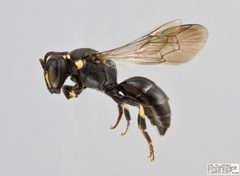
Hylaeus affinis, commonly known as the eastern masked , is a small solitary bee in the Colletidae. It is native to North America and belongs to the Hylaeus, whose members are often called masked bees or yellow-faced bees due to their distinctive facial markings. Like other Hylaeus , it is nearly hairless and resembles small in appearance. The species nests in pre-existing cavities and transports pollen and nectar internally rather than on body hairs.
Pronunciation
How to pronounce Hylaeus affinis: /haɪˈliːəs əˈfɪnɪs/
These audio files are automatically generated. While they are not always 100% accurate, they are a good starting point.
Identification
Hylaeus affinis can be distinguished from other Hylaeus by specific facial marking patterns. Females have yellow, white, or ivory markings on the inner margin of each , while males have the entire colored yellow or white. The species is nearly hairless with a -like appearance, lacking the dense branched hairs typical of most bees. Microscopic examination (60x magnification) reveals , feather-like hairs characteristic of bees rather than the simple unbranched hairs of wasps. The small size and slender build further distinguish masked bees from bumble bees and honey bees.
Images
Habitat
Hylaeus affinis occupies environments where pre-existing nesting cavities occur, including areas with hollow stems, pithy twigs, and abandoned insect burrows in soil. The has been documented in Vermont and occurs across North America in settings that provide suitable nesting substrates and floral resources.
Distribution
North America, with confirmed records from Vermont, United States. The ' range extends across the continent within suitable zones.
Life Cycle
Hylaeus affinis is solitary, with each female constructing and provisioning her own nest. Nests are established in pre-existing cavities such as hollow stems, pithy twigs, or abandoned burrows. Females line individual with a glandular secretion that forms a natural polymer (cellophane-like lining) to prevent spoilage of stored provisions. The female ingests nectar and stores it in an internal crop, then regurgitates it into cells along with pollen. Each cell contains a single larva that develops on the stored provisions.
Behavior
Females forage for nectar and pollen, transporting these resources internally in a crop rather than externally on body hairs. Males lack stingers and may congregate near nesting sites, creating the impression of swarming . The readily uses artificial nest boxes constructed from bundles of straws, sumac twigs, or drilled wooden blocks.
Ecological Role
As a , Hylaeus affinis contributes to pollination of flowering plants in its range. The ' foraging activities support plant in natural and urban environments. Its use of pre-existing cavities for nesting makes it a component of utilizing dead plant material and abandoned structures.
Human Relevance
Hylaeus affinis can be encouraged in gardens and urban areas through installation of artificial nest boxes. Bundles of thin straws, sumac twigs, or wooden blocks with small diameter holes (1-6 mm) placed on south-facing walls or tree trunks at least three feet above ground with rain protection can attract nesting females. The ' -like appearance may cause mistaken identity and unnecessary concern among observers unfamiliar with native bees.
Similar Taxa
- Hylaeus basalisAnother North American Hylaeus with similar -like appearance and yellow facial markings; distinguished by specific facial pattern and geographic distribution differences.
- Hylaeus bisinuatusWestern U.S. Hylaeus with similar ; distinguished by range and documented specialization on White Sweetclover (Melilotus alba).
- Small wasps (various families)Hylaeus affinis resembles small due to sparse hair; distinguished by hairs visible under magnification and facial marking patterns of masked bees.
Sources and further reading
- BugGuide
- Wikipedia
- GBIF taxonomy match
- iNaturalist taxon
- NCBI Taxonomy
- Catalogue of Life
- Looking for Cheap Urban Real Estate | Bug Squad
- Take 2 on tropical tiger moths: Spotted oleander caterpillar moth, Empyreuma affinis — Bug of the Week
- Mason bees in peril when parasitic wasps arrive – Leucospid wasp, Leucospis affinis — Bug of the Week
- A Tick that Feeds on Birds May Increase the Range of Lyme Disease
- Bug Eric: Wasp Wednesday: Not Wasp VI
- Bug Eric: A Beautiful Place to "Bee"