
Arge scapularis
elm argid sawfly
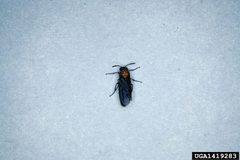
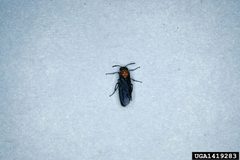
Arge scapularis, commonly known as the elm argid , is a sawfly in the Argidae found across North America. It is a herbivore that commonly infests elm trees (Ulmus spp.). The species name 'scapularis' refers to distinctive shoulder blade-like structures on the insect's . As a member of the suborder , it lacks the narrow ' waist' characteristic of many other Hymenoptera.
Pronunciation
How to pronounce Arge scapularis: //ˈɑːrdʒi skæpjʊˈlɛərɪs//
These audio files are automatically generated. While they are not always 100% accurate, they are a good starting point.
Identification
Distinguished from other by the prominent shoulder blade-like thoracic structures that give the its name. Belongs to Argidae, which can be separated from other sawfly families by antennal structure (Argidae typically have simple, unsegmented or weakly segmented , though specific details for A. scapularis are not documented). As a non-stinging sawfly, it lacks the narrow petiole (' waist') of wasps.
Images
Habitat
Associated with elm trees (Ulmus spp.) across its range. Specific microhabitat preferences for larvae or are not documented.
Distribution
Found across North America. Specific range boundaries are not well-documented in available sources.
Diet
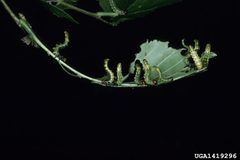
Larvae feed on elm trees (Ulmus spp.). Specific feeding habits of are not documented.
Host Associations
- Ulmus - larval food plantelm trees
Ecological Role
Herbivore that consumes elm foliage; specific ecological impacts or interactions are not documented.
Human Relevance
Considered a pest of elm trees due to larval feeding damage. Not known to sting or bite humans.
Similar Taxa
- Other Argidae speciesSimilar body plan and lack of waist; distinguished by the distinctive scapular structures and association with elm
- Apocrita waspsMay be superficially similar but possess narrow petiole (' waist') between and , which lack
More Details
Etymology
The name 'scapularis' directly references the insect's distinctive shoulder blade-like thoracic structures.
Taxonomic placement
As a member of suborder , this represents the more basal lineage of Hymenoptera, retaining a broad connection between and rather than the constricted waist of .
Sources and further reading
- BugGuide
- Wikipedia
- iNaturalist taxon
- Just in the tick of time: American dog tick, Dermacentor variabilis, and Black-legged tick, Ixodes scapularis — Bug of the Week
- In the Southern U.S., Young Blacklegged Ticks' Habitat is a Mystery
- Forest Edge, Stone Walls Are Backyard Hot Spots for Blacklegged Ticks
- Another Invasive Mosquito Species Arrives in Florida
- Cold weather arrives but don’t let your guard down for a tick attack: Blacklegged tick, Ixodes scapularis — Bug of the Week
- An Up-Close Look at the Tiny Sensory Pits That Ticks Use to Smell