
Nomada edwardsii
Cresson, 1878
Edwards' Nomad
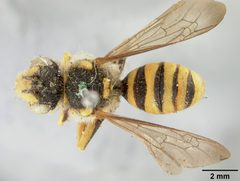
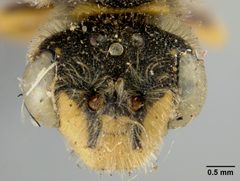
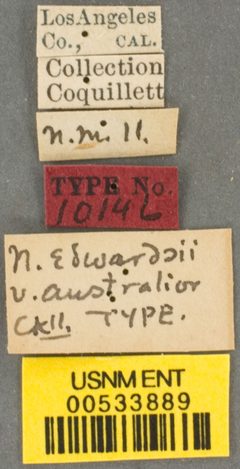
Pronunciation
How to pronounce Nomada edwardsii: /noʊˈmɑːdə ɛdˈwɔrdzi.aɪ/
These audio files are automatically generated. While they are not always 100% accurate, they are a good starting point.
Identification
Nomada edwardsii can be distinguished from other Nomada by specific morphological characters, though detailed diagnostic features are not well-documented in available sources. As with other Nomada species, it likely exhibits the typical nomad bee coloration patterns of yellow, black, and red markings. The two (N. e. edwardsii and N. e. vinnula) may show geographic variation in coloration and body proportions.
Images
Distribution
Central America and North America. The has been recorded in both Middle America and North America according to distribution data.
Host Associations
Ecological Role
As a kleptoparasitic , Nomada edwardsii functions as a in bee . It does not construct its own nests or collect pollen, instead relying on bee to provision its offspring. This parasitic lifestyle influences of host bee species and contributes to overall bee community structure.
Similar Taxa
- Nomada flavoguttataBoth are Nomada with kleptoparasitic , but N. flavoguttata is found in Europe and has been studied for its 'antennal grabbing' courtship behavior, which has not been documented in N. edwardsii
- Nomada goodenianaBoth are Nomada with similar kleptoparasitic , but N. goodeniana is a European species associated with Andrena bees
More Details
Subspecies
Two are recognized: Nomada edwardsii edwardsii Cresson, 1878 (the nominate subspecies) and Nomada edwardsii vinnula Cresson, 1879.
Research context
While detailed studies of N. edwardsii specifically are limited, research on other Nomada has revealed complex courtship including 'antennal grabbing' where males wind their around females during copulation to transfer . Whether N. edwardsii exhibits this behavior has not been documented.
Sources and further reading
- BugGuide
- Wikipedia
- GBIF taxonomy match
- iNaturalist taxon
- NCBI Taxonomy
- Catalogue of Life
- Image by UC Davis Alumnus Ian Wright Appears in ESA World Calendar | Bug Squad
- entomology | Blog - Part 10
- Northern Ireland, invertebrate finds in review 2023 - Buglife Blog - Buglife
- Not-so Solitary Bees - Buglife Blog - Buglife
- Bare ground experiments to help save rare bees and wasps - Buglife Blog - Buglife
- behaviour | Blog