
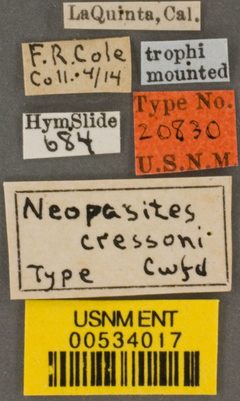
Neopasites cressoni
Crawford, 1916
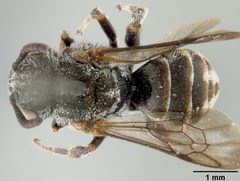
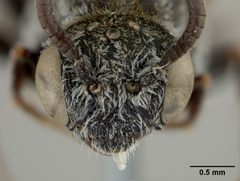
Neopasites cressoni is a kleptoparasitic (cuckoo) in the Apidae, tribe Biastini. It is native to North America and targets in the Hesperapis, a group of ground-nesting bees. Like other members of the Nomadinae , females lack pollen-collecting structures and rely entirely on host nests for . The was described by Crawford in 1916.
Pronunciation
How to pronounce Neopasites cressoni: /niː.oʊˈpæsaɪtiːz krɛˈsoʊnaɪ/
These audio files are automatically generated. While they are not always 100% accurate, they are a good starting point.
Images
Distribution
North America
Host Associations
- Hesperapis - kleptoparasitePrimary ; specific host associations have been documented but require verification
Behavior
Females enter nests to lay in provisioned by Hesperapis females. Larvae consume the host's pollen and nectar stores, killing the host egg or larva in the process.
Ecological Role
Acts as a on solitary bees, potentially influencing and nest site competition.
Similar Taxa
- Neopasites fulviventrisCongeneric with overlapping range; distinguished by subtle differences in coloration and patterns, requiring expert examination
- Other Biastini genera (Biastes, Epeoloides)Similar kleptoparasitic lifestyle and Nomadinae ; distinguished by -specific structural characters and associations
More Details
Taxonomic placement
Member of the tribe Biastini, a small group within Nomadinae characterized by associations with Hesperapis and distinctive larval . The Neopasites contains approximately 5-6 described , all restricted to North America.