
Leiopodus singularis
(Linsley & Michener, 1937)
Singular Turret-Cuckoo
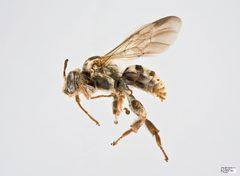
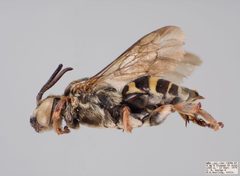
Leiopodus singularis is a kleptoparasitic in the Apidae. It is a specialized that targets the nests of Diadasia olivacea, a bee species. The species exhibits distinctive behavioral adaptations for nest infiltration, including prolonged perching outside host nests and multiple brief inspection visits before oviposition. Its involves direct larval combat where the first instar kills the much larger host larva.
Pronunciation
How to pronounce Leiopodus singularis: /ˌlaɪ.oʊˈpoʊ.dəs sɪŋˈɡjʊl.ɑː.rɪs/
These audio files are automatically generated. While they are not always 100% accurate, they are a good starting point.
Images
Distribution
Central America and North America
Diet
Larvae consume the pollen provisions collected by the Diadasia olivacea after killing the host larva. do not collect pollen or nectar; they are that rely entirely on host resources for offspring development.
Host Associations
- Diadasia olivacea - kleptoparasitePrimary ; females perch outside host nests and enter to lay after the host departs
Life Cycle
have a long relative to the . First instar larvae do not feed initially but instead kill the much larger host larva, then to second instar before consuming the host's pollen provisions.
Behavior
Females perch alertly outside nests and wait for the host to leave. They make short inspection visits of approximately 20 seconds, then on the final visit enter for approximately 2 minutes to lay an . This multi-visit approach allows assessment of nest status before committing to oviposition.
Ecological Role
Acts as a that reduces reproductive success of its . By usurping pollen provisions collected by solitary bees, it influences resource allocation within and may affect pollination services provided by the host .
Similar Taxa
More Details
Conservation Status
No specific conservation assessments found; data deficient.