
Melissodes apicatus
Lovell & Cockerell, 1906
Pickerelweed Longhorn Bee
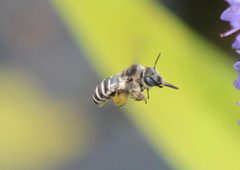
Melissodes apicatus, commonly known as the pickerelweed longhorn , is a solitary bee in the Apidae and tribe Eucerini. Males possess disproportionately long , a characteristic trait of longhorn bees. The species is native to eastern North America and has been documented pollinating Pontederia (pickerelweed), among other plants. Unlike social bees, it does not form colonies or store honey, though females may nest in .
Pronunciation
How to pronounce Melissodes apicatus: /mɛˈlɪsəˌdiz æpɪˈkeɪtəs/
These audio files are automatically generated. While they are not always 100% accurate, they are a good starting point.
Identification
Males can be recognized by their elongated , distinguishing them from females and from bees outside the Eucerini tribe. Within the Melissodes, precise identification to level requires examination of morphological details not summarized in available sources. The "pickerelweed longhorn " references its association with Pontederia, which may aid field recognition where that plant occurs.
Images
Appearance
Males have conspicuously long relative to body size, a defining feature of the Eucerini tribe. The exhibits typical longhorn with a robust, moderately hairy body. Specific coloration and body size details for this species are not well documented in available sources.
Habitat
Associated with wetland and aquatic margin where Pontederia (pickerelweed) grows. Documented in states with suitable freshwater environments supporting this plant. Specific nesting substrate preferences are not detailed in available sources.
Distribution
Native to eastern United States and southeastern Canada. Recorded in North Carolina, Indiana, Illinois, Pennsylvania, New York, Connecticut, Vermont, Wisconsin, Minnesota, and the Canadian provinces of Ontario and Quebec. Westernmost well-documented occurrence in Illinois, with observations extending to Minnesota.
Diet
feed on nectar and pollen. Documented floral associations include Pontederia (pickerelweed) for females, and Hydrocotyle, Melilotus, and Stachys for males. Specific pollen specialization status is not confirmed in available sources.
Life Cycle
Solitary nesting ; females construct individual burrows in soil rather than forming colonies. Each female digs her own nest burrow. Males do not participate in nest construction or provisioning. Developmental timing and number of per year are not documented in available sources.
Behavior
Males have been observed sleeping in on vegetation, a documented in other Melissodes . Males are unable to sting, lacking the modified ovipositor that forms the stinger in females. Females may nest in loose aggregations with nests in close proximity, though each maintains an individual burrow.
Ecological Role
Documented of Pontederia and associated with other flowering plants. Contributes to pollination services in freshwater wetland where it occurs.
Human Relevance
May serve as an for healthy wetland supporting pickerelweed. No documented agricultural use or economic importance. Not known to be a nuisance or stinging hazard from males; female defensive is not described in available sources.
Similar Taxa
- Other Melissodes speciesShare long in males and general body form; require detailed morphological examination for separation.
- Svastra obliquaRelated longhorn in tribe Eucerini with similar male sleeping ; distinguished by -level characters.
More Details
Taxonomic note
Described by Lovell & Cockerell in 1906. The epithet "apicatus" may reference the apex or tip, possibly alluding to antennal or other morphological features.
Data limitations
This has received limited focused study; much information is inferred from -level characteristics or congeneric species. iNaturalist records (47 observations as of source date) suggest it is infrequently encountered or underreported relative to more common Melissodes species.
Sources and further reading
- BugGuide
- Wikipedia
- GBIF taxonomy match
- iNaturalist taxon
- Catalogue of Life
- About Those Sleepovers... | Bug Squad
- The Year 2017: 'Survival of the Flittest' | Bug Squad
- What's Not to Love About 'Boys' Night Out'? | Bug Squad
- 2023: These Are a Few of My Favorite Things | Bug Squad
- Seen Any Monarchs Lately? | Bug Squad
- 'Bee' One in a Million | Bug Squad