
Bombus caliginosus
(Frison, 1927)
obscure bumblebee, Fog-belt Bumble Bee
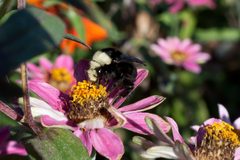
Bombus caliginosus, commonly known as the obscure bumblebee or Fog-belt , is a bumblebee native to the Pacific coast of the United States. Its range extends from Washington through Oregon to Southern California, reaching as far south as the San Jacinto Mountains. The species is morphologically similar to the yellow-faced bumblebee (B. vosnesenskii), requiring examination of male genitalia for definitive identification. It exhibits pronounced seasonality, with queens emerging from hibernation in late January, appearing in early March, and males emerging by late April.
Pronunciation
How to pronounce Bombus caliginosus: /ˈbɒmbəs kælɪˈdʒɪnəsəs/
These audio files are automatically generated. While they are not always 100% accurate, they are a good starting point.
Identification
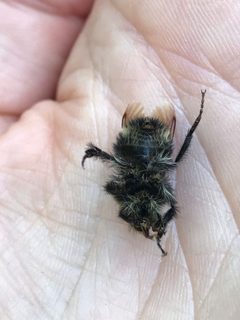
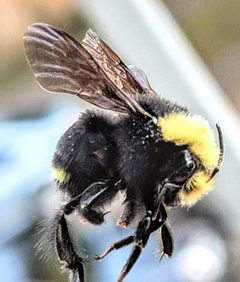
Bombus caliginosus is nearly indistinguishable from Bombus vosnesenskii (yellow-faced bumblebee) based on external alone; definitive identification requires examination of male genitalia structure. The tends to have longer body hairs than B. vosnesenskii. A distinguishing feature is the presence of yellow hairs on the underside of the , whereas B. vosnesenskii has only black hairs ventrally.
Images
Habitat
Coastal and near-coastal environments of the Pacific West; specific microhabitat preferences are not well documented in available sources.
Distribution
Pacific coast of the United States: Washington, Oregon, and California, extending south to the San Jacinto Mountains in Southern California.
Seasonality
Queens emerge from hibernation in late January. First appear in early March. Males emerge by late April. Colonies dissolve in late October, when all inhabitants except new queens die.
Diet
have been documented foraging on 19 plant , most frequently Fabaceae (legumes). Queens are most often observed on Ericaceae (heath family). Males are most frequently recorded on Asteraceae (aster family). Documented plants include ceanothus, thistles, sweet peas, lupines, rhododendrons, Rubus, willows, and clovers.
Life Cycle
colony cycle with solitary queens. Queens establish nests in spring, produce cohorts, then male and new offspring in late summer. Colony occurs in late October; only newly mated queens survive winter.
Ecological Role
of native flowering plants and some agricultural crops; contributes to pollination of Fabaceae, Ericaceae, and Asteraceae in its native range.
Human Relevance
Subject of conservation monitoring through the California Bumble Bee Atlas. Potential candidate for state designation discussions in California. No documented commercial use.
Similar Taxa
- Bombus vosnesenskiiNearly identical external ; distinguished by male genitalia structure, longer hairs in B. caliginosus, and presence of yellow abdominal hairs ventrally (black only in B. vosnesenskii)
Sources and further reading
- BugGuide
- Wikipedia
- GBIF taxonomy match
- iNaturalist taxon
- NCBI Taxonomy
- Catalogue of Life
- Celebrating Bumble Bees on World Bee Day | Bug Squad
- Bumble Bee Mellowing Out on the Mallow | Bug Squad
- The Buzz: Protecting Our Bumble Bees | Bug Squad
- California Has No State Bee--Yet! | Bug Squad
- Saving California's Bumble Bees: Become a Citizen Scientist | Bug Squad
- Bumble Bees: Feeling Impact of Climate Change | Bug Squad