
Bombus borealis
Kirby, 1837
Northern Amber Bumble Bee, Northern Amber Bumblebee
Bombus borealis is a medium-sized bumblebee native to northern North America, recognized by its predominantly yellow body coloration with pale to white hairs on the . The occupies woodland across Canada, Alaska, and the northern and eastern United States, where it nests underground and males congregate near nest sites to seek mates.
Pronunciation
How to pronounce Bombus borealis: /ˈbɒm.bəs bɔːˈriː.ælɪs/
These audio files are automatically generated. While they are not always 100% accurate, they are a good starting point.
Identification
The combination of uniformly yellow body with pale/white hairs distinguishes B. borealis from many other North American Bombus that typically show black banding or more contrasting color patterns. The amber overall appearance and woodland association provide additional field clues. Males can be distinguished by their size range and genital .
Images
Appearance
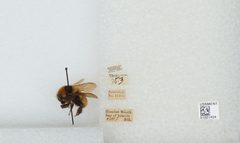
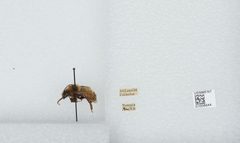
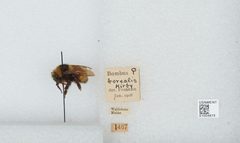
Queens measure 18–22 mm in length with yellow body hairs and pale to white hairs on the . are similarly colored and measure approximately 13 mm. Males range from 14–17 mm in length and share the yellow and pale coloration pattern.
Habitat
Primarily found in woodland . Nests are constructed underground, typically in concealed locations within forested environments.
Distribution
Native to northern North America. Occurs across Canada and Alaska, and extends into the northern and eastern contiguous United States.
Diet
Feeds on nectar and pollen from multiple plant including milkvetches (Astragalus), thistles (Cirsium), wild blackberries (Rubus), goldenrods (Solidago), comfrey (Symphytum), clovers (Trifolium), and vetches (Vicia).
Life Cycle
Behavior
Males exhibit mate-seeking by congregating in the vicinity of nests. The performs buzz pollination, vibrating muscles to dislodge pollen from flowers.
Ecological Role
of wild flowering plants and potentially agricultural crops within its range. Contributes to plant through both nectar collection and buzz pollination services.
Human Relevance
Potential value in northern agricultural and horticultural systems. Not known to be commercially reared.
Similar Taxa
- Bombus fervidusAlso yellow-dominated, but typically shows more extensive black on the and has a more southern distribution; B. borealis is distinguished by its northern range and woodland preference
- Other yellow Bombus speciesMost North American bumblebees show black banding or more complex patterns; the relatively uniform amber-yellow coloration with pale is distinctive for B. borealis
More Details
Nesting biology
Underground nesting habit may provide protection from environmental extremes and , though specific nest site requirements are not well documented.
Male aggregation
Male congregation near nests is a characteristic mating system feature, though the specific cues used for have not been studied in detail.
Sources and further reading
- BugGuide
- Wikipedia
- GBIF taxonomy match
- iNaturalist taxon
- NCBI Taxonomy
- Catalogue of Life
- ESA Entomology Games Are Both Educational and Entertaining | Bug Squad
- Celebrating Bumble Bees on World Bee Day | Bug Squad
- Bumble Bee Mellowing Out on the Mallow | Bug Squad
- The Buzz: Protecting Our Bumble Bees | Bug Squad
- Bugs for All, All for Bugs | Bug Squad
- Robbin Thorp: Chasing Franklin's Bumble Bee | Bug Squad