
Bombus ashtoni
(Cresson, 1864)
Ashton's cuckoo bumble bee
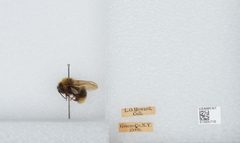
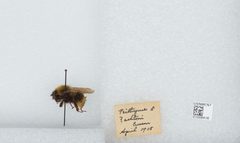
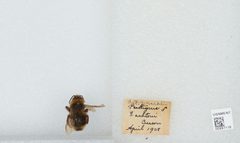
Bombus ashtoni is a cuckoo (subgenus Psithyrus) native to North America. Unlike social bumble bees, this does not produce or construct its own nests. Instead, females infiltrate established colonies of other Bombus species and exploit the workers to rear their own offspring. This parasitic lifestyle has been documented specifically with hosts including Bombus affinis, Bombus terricola, and Bombus fervidus. The species is subject to the same conservation concerns affecting its host species, particularly the endangered rusty patched bumble bee (B. affinis).
Pronunciation
How to pronounce Bombus ashtoni: /ˈbɒm.bəs ˈæʃ.tə.naɪ/
These audio files are automatically generated. While they are not always 100% accurate, they are a good starting point.
Identification
As a member of the subgenus Psithyrus, B. ashtoni can be distinguished from non-parasitic Bombus by the absence of pollen-carrying corbiculae () on the hind legs of females. Cuckoo bumble bees also lack the dense body hair typical of social species, appearing relatively sleek. Specific identification to species level requires examination of coloration patterns and microscopic features; B. ashtoni exhibits particular combinations of black, yellow, and sometimes reddish or white markings that distinguish it from other Psithyrus species in its range.
Images
Distribution
North America. The has been recorded in the United States and Canada, with its distribution corresponding to that of its species. Specific state and provincial records align with the ranges of Bombus affinis (now largely restricted to the upper Midwest), Bombus terricola (northern and montane regions), and Bombus fervidus (transcontinental in northern areas).
Host Associations
- Bombus affinis - social Primary ; B. affinis is federally endangered in the United States
- Bombus terricola - social Known
- Bombus fervidus - social Known
Life Cycle
Females emerge from hibernation in spring and seek out established colonies. The cuckoo female kills or subdues the host and assumes reproductive control of the colony. She lays that are tended by host , which also provision the developing cuckoo larvae. Male and female offspring are produced; mated females enter to overwinter and repeat the cycle the following year. No worker is produced—this relies entirely on host workers for colony maintenance.
Behavior
Females engage in aggressive usurpation of colonies, often killing the resident upon entry. This exhibits the cuckoo : females possess a thick, heavily sclerotized and mandibular structures adapted for combat with host queens. Males patrol areas near host colonies seeking mates. The species does not forage for pollen or nectar to provision offspring, though may visit flowers for their own nutritional needs.
Ecological Role
As an obligate social , B. ashtoni functions as a regulator of its . Its persistence is entirely dependent on healthy host populations. The species may contribute to local extinction of host colonies, though at natural population levels this is balanced by host and . The decline of host species, particularly B. affinis, threatens the long-term viability of B. ashtoni populations.
Human Relevance
The has no direct economic value, but its conservation status is linked to that of its , including the agriculturally important rusty patched . B. ashtoni serves as an indicator of bumble bee health and intact ecological interactions. Its presence in an area confirms functioning of host species. The species is of interest to conservation biologists studying decline and parasitic .
Similar Taxa
- Bombus (Psithyrus) citrinusAnother cuckoo with overlapping eastern range; distinguished by color pattern and associations
- Bombus (Psithyrus) insularisWidespread cuckoo with broader range; B. ashtoni more specialized to particular host species
- Bombus (Psithyrus) fernaldaeSimilar size and coloration; requires careful examination of abdominal pattern and markings for separation
More Details
Conservation concern
The status of B. ashtoni is directly tied to that of its . The dramatic decline of Bombus affinis, which has lost approximately 90% of its historic range and was listed as endangered in 2017, poses a significant threat to B. ashtoni in the upper Midwest. The species may qualify for conservation attention under the logic of host- coextinction risk, though it receives no independent legal protection.
Sources and further reading
- BugGuide
- Wikipedia
- GBIF taxonomy match
- NCBI Taxonomy
- Catalogue of Life
- Celebrating Bumble Bees on World Bee Day | Bug Squad
- Bumble Bee Mellowing Out on the Mallow | Bug Squad
- The Buzz: Protecting Our Bumble Bees | Bug Squad
- California Has No State Bee--Yet! | Bug Squad
- Saving California's Bumble Bees: Become a Citizen Scientist | Bug Squad
- Bumble Bees: Feeling Impact of Climate Change | Bug Squad