
Anthophora terminalis
Cresson, 1869
Orange-tipped Wood-digger
Anthophora terminalis is a solitary anthophorine in the Apidae, known for its distinctive nesting in wood and other substrates. The constructs using chewed sawdust or wood fibers, lining them with salivary secretions. It has been documented across North America and parts of Europe and Northern Asia, with specific studies in Wisconsin revealing details of its and nest architecture. have been observed foraging on several plant species including Stachys palustris, Nepeta cataria, and Epilobium angustifolium.
Pronunciation
How to pronounce Anthophora terminalis: //ænˈθɒfərə tɜːˈmɪnəlɪs//
These audio files are automatically generated. While they are not always 100% accurate, they are a good starting point.
Identification
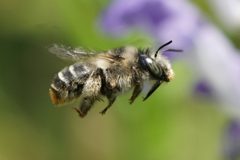
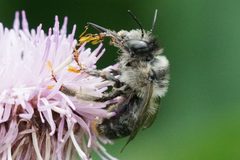
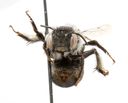
Distinguished from other Anthophora by its nesting substrate preferences and geographic distribution. The species has been recorded in wooden trap-nesting blocks and dead poplar logs, using sawdust chewed from hole walls to construct . Females precede males in cell arrangement within nests—a pattern that may aid identification when nest contents are examined. The "Orange-tipped Wood-digger" suggests distinctive coloration at abdominal terminus, though specific diagnostic features require direct specimen examination.
Images
Habitat
Nests in pre-existing cavities in wood including sumac sticks, dead poplar logs, and wooden trap-nesting blocks. The utilizes holes drilled in trap-nests or natural cavities, modifying them with sawdust partitions and salivary linings.
Distribution
North America; Europe and Northern Asia (excluding China). Documented in Wisconsin through extensive trap-nest studies (1952-1962).
Seasonality
One per year in Wisconsin, with activity and nesting occurring during the growing season.
Diet
forage for nectar and pollen. Recorded floral include Stachys palustris (woundwort), Nepeta cataria (catnip), and Epilobium angustifolium (fireweed).
Life Cycle
(one per year) in Wisconsin. Nests contain 1-11 (mean 5.8), with cells constructed sequentially. Larvae develop within cells on provisioned pollen and nectar masses, but do not spin cocoons—this trait complicates rearing. In nests containing both sexes, females are invariably positioned in earlier cells than males.
Behavior
Females construct using sawdust chewed from the walls of the nesting hole, mixing it with salivary secretions to form partitions between cells and to line cell interiors. A sawdust plug is constructed above the last cell, typically positioned a few inches from the nest entrance. The provisions stored in cells characteristically develop a "sour" odor and frequently spoil, which has hampered successful rearing of in studies.
Ecological Role
As a solitary , likely contributes to pollination of its recorded floral . The ' use of wood cavities and specific construction techniques may influence microbial within nests.
Human Relevance
Has been studied extensively using trap-nest methodologies, contributing to understanding of solitary nesting . The ' willingness to use artificial trap-nests makes it potentially useful for monitoring and conservation research.
Sources and further reading
- BugGuide
- Wikipedia
- GBIF taxonomy match
- iNaturalist taxon
- NCBI Taxonomy
- Catalogue of Life
- Digging the Digger Bees and the Newly Published Research | Bug Squad
- UC Davis: All A'Buzz With Bee Nests and Art | Bug Squad
- Congratulations, Microbiologist Shawn Christensen: Best Dissertation | Bug Squad
- The Beckoning Bees at Bodega Bay | Bug Squad
- A Silver Digger Bee in Flight at Bodega Head | Bug Squad
- California Has No State Bee--Yet! | Bug Squad
- Anthophora (Clisodon) terminalis Cresson in Trap-nests in Wisconsin (Hymenoptera: Anthophoridae)
- Record of Anthophora (Clisodon) terminalis in a wooden trap-nesting block and comparison to available nesting information (Hymenoptera: Apidae)