
Andrena wilkella
(Kirby, 1802)
Wilke's Mining Bee, Wilke's Mining-bee
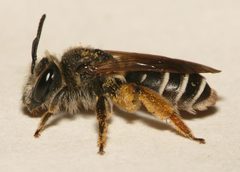
Andrena wilkella is a solitary mining bee in the Andrenidae. Native to Europe, it has been introduced to North America, possibly via ship ballast. It is active from April to August and nests both singly and in . The shows strong pollen specialization on Fabaceae, particularly clover and sweet clover.
Pronunciation
How to pronounce Andrena wilkella: /ænˈdriːnə wɪlˈkɛlə/
These audio files are automatically generated. While they are not always 100% accurate, they are a good starting point.
Identification
Distinguished from other Andrena by its association with Fabaceae pollen sources and its period from late May onward. The Blunt-jawed Nomad Bee (Nomada striata) is a known kleptoparasite, so its presence may indicate A. wilkella nesting nearby. Precise identification requires examination of microscopic features not covered in available sources.
Images
Appearance
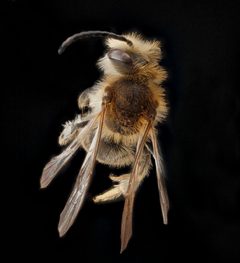
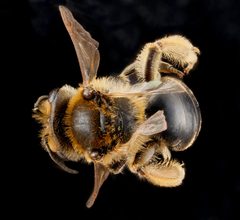
Female body length 10–12 mm; male body length 9–11 mm. As a member of the Andrena, it has the typical mining bee with a moderately robust body, hairy , and scopae (pollen-collecting hairs) on the hind legs of females. Specific coloration and pattern details are not documented in available sources.
Habitat
Requires warm, dry, bare soil for nesting. Nests in open, sparsely vegetated ground including compacted bare ground on paths and banks. Found in grasslands, heathlands, and other open with suitable nesting substrate and Fabaceae plants.
Distribution
Native to Europe; introduced to North America with established . GBIF records indicate presence also in Africa and Southern Asia, though these may represent additional introductions or misidentifications.
Seasonality
activity from April to August; in the UK, specifically noted from late May following the Ashy Mining Bee (Andrena cineraria).
Diet
Strongly oligolectic on Fabaceae, preferentially collecting pollen from clover (Trifolium) and sweet clover (Melilotus). Nectar sources not specifically documented.
Host Associations
- Fabaceae - pollen sourceStrong preference for clover and sweet clover
Life Cycle
Solitary with . Females excavate underground tunnels, provision with Fabaceae pollen and nectar, lay , and seal cells with soil. Larvae develop in dry, warm conditions. emerge the following spring. Nests may be constructed singly or in .
Behavior
Nests both solitarily and in . Females actively provision nest with pollen; males emerge earlier and patrol nesting areas seeking mates.
Ecological Role
Human Relevance
Introduced to North America, where it has become established. Its preference for clover pollen may contribute to pollination of agricultural forage crops. Bare ground requirements bring it into conflict with management practices that promote dense vegetation.
Similar Taxa
- Andrena cinerariaSimilar size and nesting habits; distinguished by earlier period (early May) and panda-like black-and-white coloration
- Andrena nigroaeneaSimilar size and ground-nesting ; distinguished by earlier (mid-April) and buffish coloration
- Andrena barbilabrisSimilar ground-nesting habits; distinguished by preference for sandy substrates and different period
Sources and further reading
- BugGuide
- Wikipedia
- GBIF taxonomy match
- iNaturalist taxon
- NCBI Taxonomy
- Catalogue of Life
- Not-so Solitary Bees - Buglife Blog - Buglife
- Northern Ireland, invertebrate finds in review 2023 - Buglife Blog - Buglife
- In a New Study, Spring Forest Bees Get Their Due
- Bare ground experiments to help save rare bees and wasps - Buglife Blog - Buglife
- What’s in a name….? - Buglife Blog - Buglife
- Bees of the Changing Chalk Partnership Area - Buglife Blog - Buglife