
Andrena transnigra
Viereck, 1904
Black-banded Mining Bee, Black-banded Miner Bee
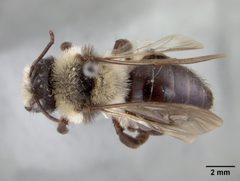
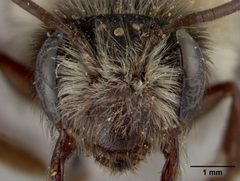
Andrena transnigra is a of mining bee in the Andrenidae, commonly known as the Black-banded Mining Bee. It is a solitary, ground-nesting native to North America. As a member of the Andrena, it shares the typical characteristics of mining bees, including nesting habits and solitary lifestyle without colonial social structure.
Pronunciation
How to pronounce Andrena transnigra: //ænˈdɹiː.nə trænsˈnɪɡ.rə//
These audio files are automatically generated. While they are not always 100% accurate, they are a good starting point.
Identification
The name 'transnigra' (meaning 'across black') suggests distinctive dark banding patterns, though specific diagnostic features distinguishing it from other Andrena species are not documented in available sources. As with many Andrena species, identification likely requires examination of microscopic morphological features such as facial foveae, scopal hairs, and genitalia structure.
Images
Distribution
North America. Specific range details within this continent are not documented in available sources.
Life Cycle
As a member of the Andrena, this exhibits the typical mining bee : solitary females excavate underground nests in soil, provision individual with pollen and nectar, lay , and seal cells before the next develops through complete (egg, larva, pupa, ). However, specific details for this species are not documented.
Ecological Role
As a solitary mining bee, this likely contributes to pollination of spring-blooming wildflowers and may serve as a for cleptoparasitic bees (Nomada species) and other , though specific ecological interactions are not documented.
More Details
Taxonomic Note
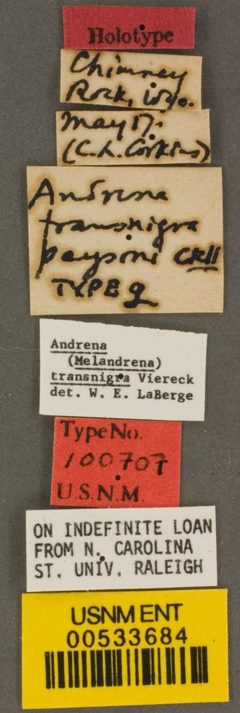
The was described by Viereck in 1904. It belongs to the large Andrena, which contains over 1,500 species globally and approximately 500 in North America.
Data Deficiency
This has only 24 observations recorded on iNaturalist as of the knowledge cutoff, indicating it is likely under-documented or genuinely uncommon. Basic biological information including plant associations, nesting substrate preferences, and precise geographic range remain unknown.
Sources and further reading
- BugGuide
- Wikipedia
- GBIF taxonomy match
- iNaturalist taxon
- Catalogue of Life
- Not-so Solitary Bees - Buglife Blog - Buglife
- Northern Ireland, invertebrate finds in review 2023 - Buglife Blog - Buglife
- In a New Study, Spring Forest Bees Get Their Due
- Bare ground experiments to help save rare bees and wasps - Buglife Blog - Buglife
- What’s in a name….? - Buglife Blog - Buglife
- Bees of the Changing Chalk Partnership Area - Buglife Blog - Buglife