
Andrena fracta
Casad & Cockerell, 1896
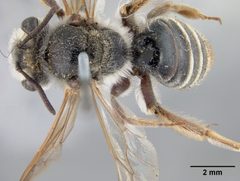
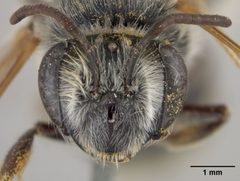
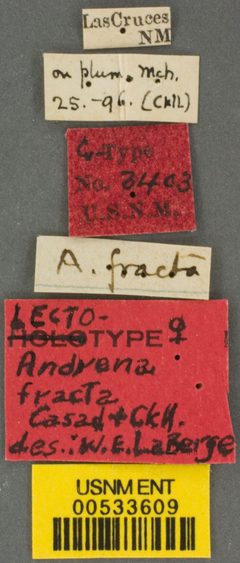
Andrena fracta is a of mining bee in the Andrenidae, first described by Casad and Cockerell in 1896. As a member of the large Andrena, it belongs to a group of solitary, ground-nesting bees that are important in temperate and subtropical regions. The species has been recorded from North America and Middle America, though detailed ecological and biological information remains limited. Like other Andrena species, it likely nests in burrows excavated in soil and provisions its larvae with pollen and nectar.
Pronunciation
How to pronounce Andrena fracta: /ænˈdriːnə ˈfræk.tə/
These audio files are automatically generated. While they are not always 100% accurate, they are a good starting point.
Images
Distribution
Recorded from North America and Middle America based on distribution records. Specific locality details are sparse in available sources.
Ecological Role
As a solitary in the Andrenidae, it likely contributes to pollination of wildflowers and potentially agricultural crops in its range, though specific plant associations have not been documented.
Sources and further reading
- BugGuide
- GBIF taxonomy match
- iNaturalist taxon
- Catalogue of Life
- Not-so Solitary Bees - Buglife Blog - Buglife
- Northern Ireland, invertebrate finds in review 2023 - Buglife Blog - Buglife
- In a New Study, Spring Forest Bees Get Their Due
- Uncategorized | Blog - Part 21
- Bare ground experiments to help save rare bees and wasps - Buglife Blog - Buglife
- What’s in a name….? - Buglife Blog - Buglife