
Andrena erythrogaster
(Ashmead, 1890)
Red-tailed Mining Bee, red-tailed andrena, red-bellied miner bee
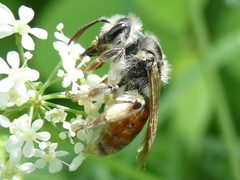
Andrena erythrogaster is a solitary mining bee native to North America. As a member of the large Andrena, it exhibits the typical ground-nesting characteristic of mining bees. The is distinguished by its reddish abdominal coloration, reflected in both its scientific and . Like other Andrena species, it is a spring-active that nests in excavated burrows in soil.
Pronunciation
How to pronounce Andrena erythrogaster: //ænˈdriːnə ɛˌrɪθroʊˈɡæstər//
These audio files are automatically generated. While they are not always 100% accurate, they are a good starting point.
Identification
The can be recognized by its reddish or orange-red abdominal coloration ("erythrogaster" = red belly). Females carry pollen on scopae located on the hind legs. As with many Andrena species, males typically emerge before females and may be observed in near nesting awaiting female . Positive identification to species level requires examination of morphological details including facial foveae in females and genitalia in males.
Images
Distribution
Native to North America. Documented from the northeastern United States including Vermont.
Seasonality
Spring-active , with activity beginning in mid to late spring. Males emerge before females, a pattern typical of the .
Life Cycle
As a solitary , females excavate individual nest burrows in soil, construct , provision each with pollen and nectar, lay a single per cell, and seal the cell before constructing the next. Larvae develop within the sealed cells, pupate, and emerge as the following spring. No is produced.
Behavior
Nests in where multiple females utilize suitable patches of bare or sparsely vegetated ground. Males patrol nesting areas and compete for access to emerging females.
Ecological Role
of spring-blooming plants. As a ground-nesting solitary , it contributes to soil aeration through its nesting activities.
Human Relevance
Contributes to pollination services in natural and potentially agricultural . Like many native bees, may be affected by loss, exposure, and competition from managed non-native bees.
Sources and further reading
- BugGuide
- Wikipedia
- GBIF taxonomy match
- iNaturalist taxon
- NCBI Taxonomy
- Catalogue of Life
- Not-so Solitary Bees - Buglife Blog - Buglife
- Northern Ireland, invertebrate finds in review 2023 - Buglife Blog - Buglife
- In a New Study, Spring Forest Bees Get Their Due
- Bare ground experiments to help save rare bees and wasps - Buglife Blog - Buglife
- What’s in a name….? - Buglife Blog - Buglife
- Bees of the Changing Chalk Partnership Area - Buglife Blog - Buglife