
Andrena cornelli
Viereck, 1907
Azalea Mining Bee, azalea miner
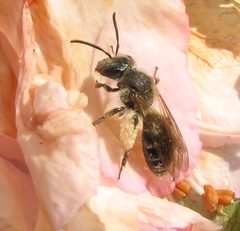
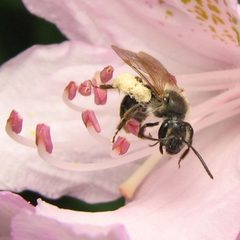
Andrena cornelli is a solitary mining bee in the Andrenidae, commonly known as the Azalea Mining Bee. It is the only known that is oligolectic on azalea (Rhododendron spp.), meaning it exclusively collects pollen from this plant . The species possesses widely spaced scopa hairs on its hind legs, an that allows it to carry the distinctive sticky pollen of azaleas. It is found in North America and is of ecological interest due to its highly specialized pollination relationship.
Pronunciation
How to pronounce Andrena cornelli: /ænˈdriːnə kɔrˈnɛlaɪ/
These audio files are automatically generated. While they are not always 100% accurate, they are a good starting point.
Identification
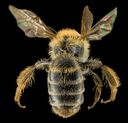
The Azalea Mining Bee can be distinguished from other Andrena by its widely spaced scopa hairs, a morphological for carrying azalea pollen. This trait is unique among bees and serves as a key diagnostic feature. Identification to species level requires examination of scopal hair and spacing, as well as association with Rhododendron plants during foraging.
Images
Habitat
containing azalea (Rhododendron spp.) plants, which serve as the exclusive pollen source. As a ground-nesting mining bee, it requires bare or sparsely vegetated soil for nest excavation.
Distribution
North America. Distribution records include the United States, with confirmed presence in Vermont.
Diet
Oligolectic on azalea (Rhododendron spp.); exclusively collects pollen from this plant . Nectar sources are not specified in available sources.
Host Associations
- Rhododendron - pollen exclusive pollen source; oligolectic relationship
Behavior
Nests in the ground by excavating tunnels, typical of mining bees. Females provision nest with azalea pollen and nectar for larval development.
Ecological Role
Specialized of azalea (Rhododendron spp.). The ' unique scopal hair enables effective pollen collection and transfer for this plant , suggesting a coevolved mutualism.
Similar Taxa
- Other Andrena speciesMost Andrena are polylectic with dense, closely spaced scopa hairs. A. cornelli is distinguished by widely spaced scopa hairs and exclusive association with Rhododendron.
More Details
Morphological specialization
The widely spaced scopa hairs represent a rare example of morphological to a specific pollen type among bees. Azalea pollen is sticky and requires this modified structure for effective transport.
Sources and further reading
- BugGuide
- Wikipedia
- GBIF taxonomy match
- iNaturalist taxon
- Catalogue of Life
- Not-so Solitary Bees - Buglife Blog - Buglife
- Northern Ireland, invertebrate finds in review 2023 - Buglife Blog - Buglife
- In a New Study, Spring Forest Bees Get Their Due
- Bare ground experiments to help save rare bees and wasps - Buglife Blog - Buglife
- What’s in a name….? - Buglife Blog - Buglife
- Bees of the Changing Chalk Partnership Area - Buglife Blog - Buglife