
Andrena clarkella
(Kirby, 1802)
Clark's Mining Bee, Clark's Andrena, Clarke's Mining Bee
Andrena clarkella is a solitary mining bee ( Andrenidae) found in Europe, Northern Asia (excluding China), and North America. It is one of the earliest spring-flying bees, active from March to May. The is oligolectic, specializing on willow (Salix) pollen. Females nest in bare or sparsely vegetated sandy soils, often in forest clearings and edges.
Pronunciation
How to pronounce Andrena clarkella: //ænˈdriːnə klɑːrˈkɛlə//
These audio files are automatically generated. While they are not always 100% accurate, they are a good starting point.
Identification
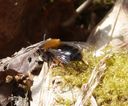
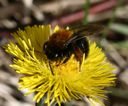
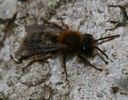
Females are readily identified in the field by their dense pilosity: black hairs on the , reddish-brown hairs on the , and fox-red hind legs with equally colored scopal brush. Small females may be confused with Andrena bicolor. Males are challenging to distinguish from congeneric and are more frequently encountered basking on tree bark than visiting flowers. The dark brown terminal fringe and loose pale tergite bands are useful characters. Microscopic examination may be required for definitive identification of males.
Images
Habitat
Forest-associated including forest fringes, clearings, and clear-cuts. Shows strong affinity for sandy soils but will nest in humus soils. Found from lowlands to subalpine elevations. Requires bare or sparsely overgrown ground for nesting.
Distribution
Europe; Northern Asia (excluding China); North America. Present across temperate regions of the Holarctic.
Seasonality
(one per year). period from early March to mid-May, making it one of the earliest spring-active bees.
Diet
Oligolectic on willows (Salix spp., Salicaceae). may nectar on additional sources but pollen collection is specialized.
Life Cycle
Solitary ground-nesting . Females excavate nests 5–30 cm below surface in sandy or humus soils, typically in small with low nest . Each nest contains 1–4 . Nest entrance is sealed before each foraging . Larvae develop on provisioned pollen-nectar masses. stage not explicitly documented in sources.
Behavior
Females exhibit nest-closing , sealing the entrance before departing on pollen/nectar collection . Males infrequently visit flowers, spending more time basking on tree bark. Nesting occurs in small rather than dense colonies.
Ecological Role
Important early spring of willows (Salix), which are ecologically significant as early nectar and pollen sources for other insects. Serves as for kleptoparasitic bees including Nomada leucophthalma and is parasitized by the -fly Bombylius major and strepsipteran Stylops melittae.
Human Relevance
Contributes to pollination of early spring-flowering plants. May benefit from conservation management that creates bare ground in forested areas. No documented economic importance or pest status.
Similar Taxa
- Andrena bicolorSmall females of A. clarkella resemble A. bicolor; requires careful examination of hair coloration and leg color to distinguish
- Other Andrena speciesMales of A. clarkella are difficult to separate from congeneric in the field without detailed examination
More Details
Etymology
Named by William Kirby in honor of Bracy Clark (1771–1860), an English entomologist.
Parasite fauna
Documented include the cuckoo bee Nomada leucophthalma, the -fly Bombylius major, and the strepsipteran Stylops melittae.
Sources and further reading
- BugGuide
- Wikipedia
- GBIF taxonomy match
- iNaturalist taxon
- NCBI Taxonomy
- Catalogue of Life
- Not-so Solitary Bees - Buglife Blog - Buglife
- Northern Ireland, invertebrate finds in review 2023 - Buglife Blog - Buglife
- In a New Study, Spring Forest Bees Get Their Due
- Bare ground experiments to help save rare bees and wasps - Buglife Blog - Buglife
- What’s in a name….? - Buglife Blog - Buglife
- Bees of the Changing Chalk Partnership Area - Buglife Blog - Buglife