
Andrena carlini
Cockerell, 1901
Carlin's Mining Bee, Carlinville Miner Bee
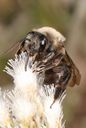
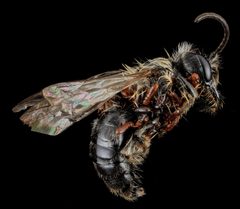
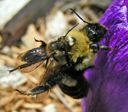
Andrena carlini is a mining bee in the Andrenidae. It is strongly associated with forest in eastern North America, where it serves as an important of spring-blooming wildflowers and woody plants. The species has been documented as prey for crab spiders and is active primarily during spring.
Pronunciation
How to pronounce Andrena carlini: //ænˈdɹiːnə kɑːrˈlaɪniː//
These audio files are automatically generated. While they are not always 100% accurate, they are a good starting point.
Images
Habitat
Strongly associated with forest . Research in New Jersey, New York, and Pennsylvania identified this as one of more than three dozen clearly forest-associated species that rarely leave woodland environments. Observations indicate activity in forest understory and woodland edges, particularly where spring-blooming plants occur.
Distribution
North America, with documented presence in the eastern United States including Vermont and Missouri. Distribution records indicate presence across forested regions of the eastern U.S.
Seasonality
Spring-flying. Active during April and May, coinciding with spring wildflower bloom in temperate eastern forests. Museum specimen records and field studies confirm spring activity period.
Diet
Feeds on nectar and pollen of spring-blooming plants. Documented visiting flowers of Amelanchier arborea (downy serviceberry). Likely pollinates forest understory wildflowers and possibly woody plants such as maples, though specific pollen associations require further documentation.
Host Associations
- Amelanchier arborea - pollen/nectar sourcemale observed as prey on flowers
Behavior
Solitary nesting inferred from characteristics, though specific nest details not available in provided sources. Males have been observed as prey for crab spiders (Mecaphesa sp.) while visiting flowers.
Ecological Role
Important spring in eastern North American forests. Contributes to pollination of spring-blooming wildflowers and potentially woody plants. Serves as prey for including crab spiders. Part of the forest that has shown increases with forest regrowth since the 1920s.
More Details
Conservation significance
trends of Andrena carlini and other forest-associated bees have been tracked through historical museum specimens from 1872 to 2011, showing increases as forests regrew following logging-era declines. This makes the an indicator of forest recovery.
Research importance
This was specifically highlighted in a 2022 Rutgers University study as one of the key examples of understudied forest-associated bees that perform much of the spring pollination work in eastern woodlands.
Sources and further reading
- BugGuide
- Wikipedia
- GBIF taxonomy match
- iNaturalist taxon
- NCBI Taxonomy
- Catalogue of Life
- In a New Study, Spring Forest Bees Get Their Due
- Oedemeridae | Beetles In The Bush
- The nest biology of the bees : Andrena (Melandrena) regularis Malloch and Andrena (Melandrena) carlini Cockerell (Hymenoptera: Andrenidae)