
Andrena alleghaniensis
Viereck, 1907
Allegheny Mining Bee, Appalachian Miner Bee, Alleghany Andrena
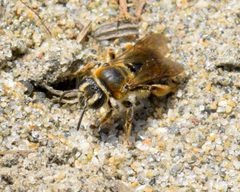
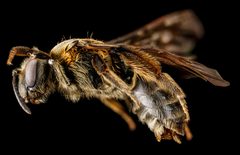
A solitary mining bee native to eastern North America. Nests are simple, typically containing only one or two . overwinter in soil, emerging in spring to forage and reproduce. The is part of the diverse Andrena , which contains many spring-flying bees associated with forest and woodland .
Pronunciation
How to pronounce Andrena alleghaniensis: //ænˈdɹiːnə æˌlɛɡəˈheɪniːɛnsɪs//
These audio files are automatically generated. While they are not always 100% accurate, they are a good starting point.
Images
Habitat
Forest and woodland in the Appalachian region. As a ground-nesting , requires access to bare or sparsely vegetated soil for nest excavation.
Distribution
Eastern North America, with confirmed records from Vermont and broader Appalachian region.
Seasonality
Spring-flying. overwinter in soil and emerge with warming temperatures.
Life Cycle
Nests contain one or two provisioned with pollen and nectar. Larvae develop within these cells. overwinter in soil, completing development before .
Behavior
Solitary. Females excavate individual nest burrows in soil. overwinter in soil rather than in above-ground cavities.
Ecological Role
of spring-blooming wildflowers and possibly trees in forest .
Sources and further reading
- BugGuide
- Wikipedia
- GBIF taxonomy match
- iNaturalist taxon
- NCBI Taxonomy
- Catalogue of Life
- Not-so Solitary Bees - Buglife Blog - Buglife
- Northern Ireland, invertebrate finds in review 2023 - Buglife Blog - Buglife
- In a New Study, Spring Forest Bees Get Their Due
- Bare ground experiments to help save rare bees and wasps - Buglife Blog - Buglife
- What’s in a name….? - Buglife Blog - Buglife
- Bees of the Changing Chalk Partnership Area - Buglife Blog - Buglife