
Ancylandrena
Cockerell, 1930
Species Guides
4- Ancylandrena atoposoma
- Ancylandrena koebelei
- Ancylandrena larreae(Creosote Bush Ancylandrena)
- Ancylandrena rozeni
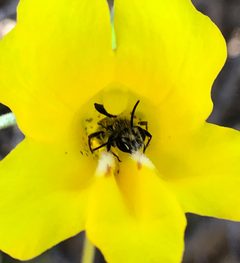
Ancylandrena is a of mining bees in the Andrenidae, established by Cockerell in 1930. The genus contains five described , all found in North America. One species, Ancylandrena larreae, is commonly known as the creosote bush ancylandrena due to its association with Larrea tridentata. These are solitary bees that nest in the ground.
Pronunciation
How to pronounce Ancylandrena: /ˌæn.sɪl.ˈæn.drɪ.nə/
These audio files are automatically generated. While they are not always 100% accurate, they are a good starting point.
Identification
Ancylandrena can be distinguished from other Andrenidae by subtle morphological characters including details of the facial foveae, scopal hairs, and male genitalia. The genus is relatively small and understudied, making field identification to species challenging without expert examination.
Images
Habitat
Associated with arid and semi-arid regions of western North America. Ancylandrena larreae is specifically tied to creosote bush scrub dominated by Larrea tridentata.
Distribution
Western North America, including the southwestern United States and adjacent regions of Mexico. The has been recorded in states such as California, Arizona, Nevada, and Texas.
Host Associations
- Larrea tridentata - floral Ancylandrena larreae is strongly associated with creosote bush, from which it derives its
Behavior
As mining bees, females excavate burrows in soil for nesting. The exhibits solitary nesting typical of Andrenidae.
Ecological Role
of desert flora, with at least one (A. larreae) serving as a pollinator of creosote bush.
Similar Taxa
- AndrenaLarger and more diverse of mining bees; Ancylandrena was historically included within Andrena before being recognized as distinct based on morphological differences
- PanurginusAnother small of Andrenidae with similar size and general appearance; distinguished by different facial foveae structure and male genitalia
More Details
Taxonomic history
The was erected by Theodore Dru Alison Cockerell in 1930 to accommodate previously placed in Andrena that showed distinct morphological features. Two species were described by Timberlake in 1951, with additional species described by Zavortink in 1974 and 1994.
Conservation status
The is poorly studied and has limited observation records; trends and conservation needs are unknown.