
Syntexis
Rohwer, 1915
cedar wood wasp, incense-cedar wood wasp
Species Guides
1- Syntexis libocedrii(incense-cedar wood wasp)
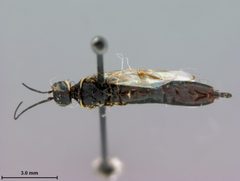
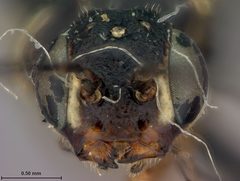
Syntexis is a of wood wasps in the Anaxyelidae, containing a single extant , Syntexis libocedrii, often called a 'living fossil' due to the family's extensive Mesozoic fossil record. The genus is notable for its obligate association with fire-damaged conifers and its prolonged larval development in living tree wood. Syntexis represents one of the most relictual lineages among extant Hymenoptera.

Pronunciation
How to pronounce Syntexis: /sɪnˈtɛksɪs/
These audio files are automatically generated. While they are not always 100% accurate, they are a good starting point.
Identification
Members of Syntexis can be distinguished from other wood wasps by their association with the Anaxyelidae, which is characterized by specific wing venation patterns including a reduced or absent forewing crossvein 1r-rs and particular arrangements of the Rs and M . The single extant has a typical siricoid body plan with a cylindrical and long , though specific diagnostic features for the level are not clearly separated from family-level characters in available sources.
Images
Habitat
Fire-damaged coniferous forests, specifically areas with recently burned incense-cedar (Calocedrus), red cedar (Thuja), or juniper (Juniperus). The shows a strong preference for post-fire environments where wood may still be smoldering during oviposition. Larval development occurs within the sapwood and heartwood of living or fire-stressed conifer trees.
Distribution
Western North America, ranging from the mountains of central California northward to southern British Columbia. The distribution closely follows that of its primary conifers, particularly Calocedrus decurrens.
Seasonality
activity occurs in spring, with from trees timed to this season. The is rarely encountered due to its cryptic habits and specific requirements.
Diet
Larvae are , feeding on the wood of living conifers. The specific nutritional involving fungal (as in related siricid wood wasps) has not been documented for this .
Host Associations
- Calocedrus decurrens - larval incense-cedar; primary for larval development in sapwood and heartwood
- Thuja - oviposition red cedar; used for -laying in fire-damaged wood
- Juniperus - oviposition juniper; used for -laying in fire-damaged wood
Life Cycle
Prolonged larval development requiring multiple years to complete. Larvae tunnel from sapwood into heartwood of living trees. emerge in spring from host trees. The extended development period in heartwood of living trees is unusual among wood-boring insects and distinguishes this from that colonize dead or dying wood.
Behavior
females exhibit remarkable of ovipositing into wood that is often still smoldering from recent fire. This pyrophilic behavior is highly specialized and represents an extreme to post-fire environments. The is very rarely observed except by firefighters or researchers specifically targeting post-fire .
Ecological Role
Wood-boring insect contributing to structural modification of living conifers. The may influence tree stress and wood decomposition processes in fire-affected forest , though quantitative impacts are undocumented. As a relictual lineage, it represents preserved ecological interactions from Mesozoic forest ecosystems.
Human Relevance
Occasionally encountered by firefighters in post-fire environments. Not considered an economic pest despite larval tunneling in living trees, due to rarity and specific associations. Scientific interest focuses on its status as a living fossil and unusual .
Similar Taxa
- SiricidaeOther wood wasp share cylindrical body form and wood-boring larvae, but differ in associations (typically dead or dying wood rather than living trees), lack the extreme pyrophilic , and have different wing venation patterns
- XiphydriidaeAnother relictual siricoid with wood-boring larvae, but distinguished by different preferences and morphological features including distinct wing venation
More Details
Fossil record
The Anaxyelidae, to which Syntexis belongs, has an extensive Mesozoic fossil record with 25 fossil and 54 described , making the single extant Syntexis species a notable relict. Fossil relatives include Orthosyntexis from mid-Cretaceous Burmese amber (99 Mya).
Taxonomic history
Originally described in the Syntexidae, now treated as Syntexinae within Anaxyelidae. The has undergone reclassification as relationships among siricoid Hymenoptera were clarified.
Sources and further reading
- BugGuide
- Wikipedia
- GBIF taxonomy match
- iNaturalist taxon
- NCBI Taxonomy
- Catalogue of Life
- Life History of the Incense-Cedar Wood Wasp, Syntexis libocedrii (Hymenoptera: Syntexidae)
- The lower crust of the Bay of Islands ophiolite, Canada: Petrology, mineralogy, and the importance of syntexis in magmatic differentiation in ophiolites and at ocean ridges
- A New Species of Orthosyntexis (Hymenoptera: Anaxyelidae) from Mid-Cretaceous Burmese Amber.