
Lecanodiaspis
Targioni Tozzetti, 1869
Species Guides
1- Lecanodiaspis prosopidis(Common Pit Scale)
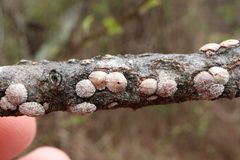
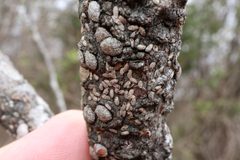
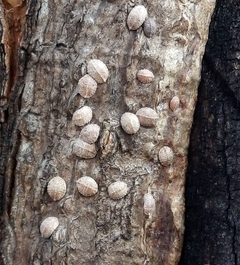
Lecanodiaspis is a of scale insects in the Lecanodiaspididae, commonly known as false pit scales. females are typically rounded to oval, slightly to strongly convex, and covered by a waxy or papery protective covering (test). The genus includes economically significant pests such as L. dendrobii, which attacks diverse plants including forestry crops and fruit trees. are found across the Americas and Asia, with some having been introduced to new regions through human activity.
Pronunciation
How to pronounce Lecanodiaspis: //lɛkəˌnoʊdaɪˈæspɪs//
These audio files are automatically generated. While they are not always 100% accurate, they are a good starting point.
Identification
Distinguished from other insect by the combination of: female with well-developed (often 9-segmented), reduced and irregularly shaped legs (2–4 segmented), and cribriform plates arranged in longitudinal rows on the dorsum. The test (protective covering) is waxy or papery and encloses the adult female and . Body shape ranges from rounded to oval, slightly to strongly convex, typically yellow to brownish-yellow in color. Some display longitudinal carinae with short conical projections on the dorsum.
Images
Habitat
Found on branches and stems of plants; recorded in reforestation areas, plantations, and rural environments. Specific records include African mahogany plantations, citrus groves, and native forest trees.
Distribution
Native range includes Republic of Guyana, Argentina, Colombia, Guatemala, Honduras, Uruguay, Venezuela, and northern Mexico. Introduced or expanding range: Brazil (Roraima state: Boa Vista, Cantá, Alto Alegre municipalities), China (Jiangxi Province).
Diet
Phloem-feeding; sap-sucking. at level, with individual showing varying breadth.
Life Cycle
females produce enclosed within the protective test. Development includes egg, nymphal instars, and adult stages for both sexes. stages disperse by wind, water, or animal at short distances; long-distance occurs via transport of infested plants.
Behavior
Forms gregarious colonies on stems and branches. Excretes honeydew, which promotes growth. Heavy cause drying of branches in mature plants and can kill young plants.
Ecological Role
Pest of forestry and fruit crops; of importance in some regions. Honeydew production supports fungi, which can compromise plant and cause premature leaf drop. Serves as host for including Cephaleta sp. (Hymenoptera: Pteromalidae), which has potential for .
Human Relevance
Economic pest affecting timber production and fruit . L. dendrobii is of particular concern due to its wide range and capacity to damage both mature and young plants. Management considerations include monitoring for as an indicator of and potential use of agents.
Similar Taxa
- Lecanodiaspis pasaniaeSimilar in having branched spiracular furrow and feeding on Fagaceae; distinguished by specific morphological details of carinae and cribriform plate arrangement
- Other Coccoidea families (e.g., Coccidae, Diaspididae)Lecanodiaspididae distinguished by combination of well-developed , reduced irregular legs, and cribriform plates in longitudinal rows; other typically have different arrangements of these features or lack cribriform plates entirely
Sources and further reading
- BugGuide
- Wikipedia
- GBIF taxonomy match
- iNaturalist taxon
- NCBI Taxonomy
- Catalogue of Life
- First report of Lecanodiaspis dendrobii Douglas, 1892 (Hemiptera: Lecanodiaspididae) and the associated parasitoid Cephaleta sp. (Hymenoptera: Pteromalidae) in Brazil
- Ocorrência de <i>Lecanodiaspis dendrobii</i> (Hemiptera: Lecanodiaspididae) e do parasitoide associado Cephaleta sp. (Hymenoptera: Pteromalidae) em mogno africano no Brasil
- A new species of Lecanodiaspis Targioni Tozzetti, 1869 (Hemiptera, Coccoidea, Lecanodiaspididae), with an updated checklist of the false pit scales of China.