
Lecanodiaspididae
false pit scales, lecanodiaspidids
Genus Guides
1is a of scale insects (Hemiptera: Coccoidea) commonly known as false pit scales. Members are found worldwide but are most diverse in the Far East. The family comprises approximately 12 described including Lecanodiaspis, Anomalococcus, and Pterococcus. These insects are phloem-feeders that develop waxy, protective coverings over their bodies.
Pronunciation
How to pronounce Lecanodiaspididae: /lɛˌkænoʊdaɪˈæspɪdɪdiː/
These audio files are automatically generated. While they are not always 100% accurate, they are a good starting point.
Identification
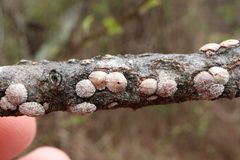
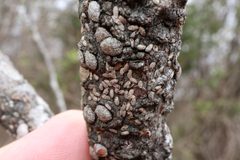
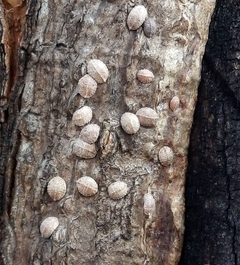
False pit scales can be recognized by the female's waxy, papery test (covering) with approximately eight transverse ridges creating a corrugated appearance. A longitudinal ridge runs through the center of the test, and the anal opening at the end has rolled-up edges. Adults are yellow to reddish-brown in color beneath the test. These features distinguish them from other insect .
Images
Habitat
Members primarily inhabit trunks and branches of shrubs and deciduous trees. They are found in tropical, subtropical, and temperate regions across diverse vegetation types including plantations, reforestation areas, and natural forests.
Distribution
Worldwide distribution with highest diversity in the Far East (East Asia). Documented from the Neotropics (Brazil, Argentina, Colombia, Guatemala, Honduras, Uruguay, Venezuela, Mexico), Australia, and other regions. The has been introduced to new areas through transport of plants.
Diet
Phloem-feeding herbivores that extract plant sap using . associations span 67 plant , with strong preference for Fabaceae. Also recorded on Fagaceae, Moraceae, Myrtaceae, Rutaceae, Anacardiaceae, Annonaceae, Verbenaceae, and Orchidaceae.
Host Associations
- Fabaceae - primary predominant
- Fagaceae -
- Moraceae -
- Myrtaceae -
- Rutaceae -
- Anacardiaceae -
- Annonaceae -
- Verbenaceae -
- Orchidaceae -
Life Cycle
Females develop through three instar stages; males develop through five instar stages. Usually one per year. are laid under the mother's test and overwinter there. Males are present in most . All developmental stages (eggs, nymphs, of both sexes) can be found together in colonies.
Behavior
Form gregarious colonies on plant stems and branches. Excrete honeydew, which attracts guards and promotes growth. Long-distance occurs via wind, water, animals, or human transport of infested host plants.
Ecological Role
Herbivores that can cause significant plant damage including drying of branches and death of young plants in heavy . Serve as for including Cephaleta sp. (Pteromalidae), Anisophleps alternata, Metaphycus terani, and Signiphora sp. Ants tend colonies for honeydew, creating multi- associations.
Human Relevance
Some are agricultural and forestry pests of importance. Lecanodiaspis dendrobii is listed as a pest of quarantine concern to the United States. Species have been evaluated as potential agents for plants, such as Anomalococcus indicus for prickly acacia (Vachellia nilotica) in Australia.
Sources and further reading
- BugGuide
- Wikipedia
- GBIF taxonomy match
- iNaturalist taxon
- NCBI Taxonomy
- Catalogue of Life
- First report of Lecanodiaspis dendrobii Douglas, 1892 (Hemiptera: Lecanodiaspididae) and the associated parasitoid Cephaleta sp. (Hymenoptera: Pteromalidae) in Brazil
- Ocorrência de <i>Lecanodiaspis dendrobii</i> (Hemiptera: Lecanodiaspididae) e do parasitoide associado Cephaleta sp. (Hymenoptera: Pteromalidae) em mogno africano no Brasil
- Life history ofAnomalococcus indicus(Hemiptera: Lecanodiaspididae), a potential biological control agent for prickly acaciaVachellia niloticassp.indicain Australia
- The host specificity ofAnomalococcus indicusAyyar (Hemiptera: Lecanodiaspididae), a potential biological control agent for prickly acacia (Vachellia niloticassp.indica) in Australia
- A new species of Lecanodiaspis Targioni Tozzetti, 1869 (Hemiptera, Coccoidea, Lecanodiaspididae), with an updated checklist of the false pit scales of China.