
Russellaspis
Bodenheimer, 1951
oleander pit scale, fig pit scale
Species Guides
1- Russellaspis pustulans(oleander pit scale)
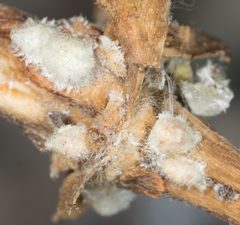
Russellaspis is a of armored scale insects (Asterolecaniidae) known primarily from the R. pustulans, commonly called the oleander pit or fig pit scale. These insects are parthenogenetic, with no known males, and are significant agricultural pests on fruit trees and ornamental plants in tropical and subtropical regions worldwide. The genus is characterized by its pit-inducing feeding damage on plants and its ability to complete multiple annually under favorable conditions.
Pronunciation
How to pronounce Russellaspis: /rʌˈsɛl.əˌspɪs/
These audio files are automatically generated. While they are not always 100% accurate, they are a good starting point.
Identification
Russellaspis are armored scale insects distinguished by their pit-inducing feeding , which creates characteristic shallow to deep depressions or galls on plant tissue. Identification to level requires examination of microscopic features of the cover and body typical of Asterolecaniidae. The genus is most reliably identified by the combination of: parthenogenetic , females with protective covers, and the distinctive pit-forming damage on hosts such as fig and oleander. Species-level identification within Russellaspis requires specialized taxonomic expertise and is complicated by the existence of poorly documented (e.g., R. pustulans principe).
Images
Habitat
Tropical and subtropical regions worldwide; restricted to indoor plantings and protected environments in cooler temperate zones. Occurs between the 10°C winter isotherm and 32°C summer isotherm. Optimal development occurs at 23–25.3°C with 68–70% relative humidity.
Distribution
Widely distributed in tropical and subtropical areas globally. In the European Union, reported in literature from Cyprus, Italy, and Malta, though these records have not been confirmed by National Plant Protection Organizations (NPPOs). Climatic conditions in southern EU member states are considered favorable for establishment.
Seasonality
Activity patterns vary by region. In Egypt, three occur annually with peaks in June, October, and December. duration ranges from 93–120 days in summer to 240–275 days in winter. Non-gravid females overwinter.
Host Associations
- Ficus carica - primary of economic importancepreferred ; : fig
- Nerium oleander - primary preferred ; : oleander
- Malus domestica - of economic importance: apple
- Psidium guajava - of economic importance: guava
- Mangifera indica - of economic importance: mango
- Olea europaea - of economic importance: olive
- Prunus persica - of economic importance: peach
- Pyrus communis - of economic importance: pear
- Prunus domestica - of economic importance: plum
Life Cycle
Parthenogenetic; males unknown. Two nymphal instars precede the stage. First instar nymphs () are mobile; second instar nymphs and adults are . Females lay beneath the protective wax cover. varies by and : 66–194 eggs per female, with 50–60 hatching on average. Average female lifespan 73–87 days (mean 80 days). Two to three generations per year depending on environmental conditions and host plant ; non-gravid females overwinter.
Behavior
First instar nymphs () serve as the primary stage, moving by over plants. Long-distance dispersal occurs via wind, (attachment to animals including birds), and incidental human transport through machinery and agricultural activities. and second instar nymphs are permanently , remaining fixed at feeding sites. Feeding induces characteristic pitting or galling at the feeding site, with damage severity varying by host and particularly conspicuous on oleander.
Ecological Role
Agricultural pest of economic significance on fruit trees and ornamentals. Serves as for including Metaphycus lounsburyi (Hymenoptera: Encyrtidae), which has been recorded as a agent in Egypt. Impact magnitude in some regions, including the European Union, remains uncertain due to limited confirmed distribution data.
Human Relevance
Significant pest of agricultural and ornamental plants. Economic damage results from pitting and galling of tissue, reducing plant vigor, fruit quality, and aesthetic value of ornamentals. Subject to phytosanitary concern in the European Union, where climatic suitability exists but establishment is not confirmed. Management relies on monitoring and may involve using such as Metaphycus lounsburyi.
Similar Taxa
- AsterolecaniumAlso in Asterolecaniidae; Russellaspis distinguished by pit-inducing feeding damage and parthenogenetic without males
- other Asterolecaniidae generaMicroscopic examination of and cover structure required for definitive separation; pit scale habit is characteristic of Russellaspis
Sources and further reading
- BugGuide
- GBIF taxonomy match
- iNaturalist taxon
- NCBI Taxonomy
- FIRST RECORD OF THE PARASITOID, METAPHYCUS LOUNSBURYI(HOWARD) (HYMENOPTERA : ENCYRTIDAE) ON FIG PIT SCALE RUSSELLASPIS PUSTULANS(COCKERELL) (HOMOPTERA : ASTEROLECANIDAE) WITH A HOST LIST OF THIS PARASITOID IN EGYPT
- Pest categorisation of Russellaspis pustulans.