
Eurygastrinae
Genus Guides
1- Eurygaster(sunn pest)
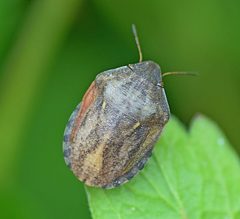
Eurygastrinae is a of shield-backed bugs within the Scutelleridae. Members are characterized by a greatly enlarged scutellum that forms a continuous shield covering the and wings. The subfamily is predominantly distributed in the Palearctic region, with notable including Eurygaster. Many are associated with grasses and cereal crops, with some considered agricultural pests.
Pronunciation
How to pronounce Eurygastrinae: //ˌjʊərɪɡæˈstrɪniː//
These audio files are automatically generated. While they are not always 100% accurate, they are a good starting point.
Identification
Distinguished from other Scutelleridae by combination of Palearctic distribution and specific genitalic and external structural characters. Eurygaster recognized by their relatively large size, rounded body outline, and often distinct color patterns with pale marginal markings on the scutellum. Separation from Scutellerinae requires examination of male genitalia and abdominal sternite structure. The entirely covered distinguishes Eurygastrinae from most other Heteroptera where the scutellum is smaller and abdominal segments remain visible.
Images
Habitat
Predominantly associated with open, dry to mesic grasslands, steppes, and agricultural fields. Many inhabit cereal crops, particularly wheat, barley, and other grasses. Also found in meadows, pastures, and disturbed with abundant Poaceae. Some species extend into montane grasslands at moderate elevations.
Distribution
Primarily Palearctic in distribution, with greatest diversity in the Mediterranean basin, Central Asia, and temperate Eurasia. Extends from Western Europe through the Middle East to Central Asia and parts of Siberia. Some have expanded ranges following agricultural practices.
Seasonality
are active primarily during spring and summer months, with peak activity coinciding with cereal crop development. Many overwinter as adults in soil litter or protected sites. Nymphal development occurs during late spring and early summer, with new adults appearing in mid to late summer depending on latitude and elevation.
Diet
Phytophagous, feeding on developing seeds of grasses (Poaceae). Many are oligophagous on cereal crops, with Eurygaster species known to feed on wheat, barley, oats, and various wild grasses. Feeding occurs primarily on developing grains, causing shriveled or aborted seeds.
Host Associations
- Triticum aestivum - food plantCommon for Eurygaster integriceps and related
- Hordeum vulgare - food plantBarley is frequently attacked by Eurygaster
- Avena sativa - food plantOats support development of several Eurygastrinae
- Poaceae - food plantVarious wild grasses serve as , particularly in non-agricultural
Life Cycle
Hemimetabolous development with , five nymphal instars, and stages. Eggs are laid in compact batches on leaves, stems, or soil surface near plants. Nymphs develop through five instars over 4-6 weeks, feeding on developing grass seeds. Adults are long-lived, often surviving several months, and may undergo reproductive . Typically , with one per year in temperate regions; partial second generations possible in warmer climates.
Behavior
and nymphs are relatively sedentary when feeding, remaining on individual seed for extended periods. Adults are capable of and may disperse to new patches. When disturbed, adults may release defensive secretions from metathoracic . adults seek shelter in soil crevices, leaf litter, or under stones. of overwintering adults have been observed in suitable .
Ecological Role
Primary consumers in grassland and agricultural , converting plant to insect biomass. Serve as prey for various including birds, spiders, and predatory insects. Some reach pest densities in agricultural systems, influencing crop management practices and associated dynamics. Seed feeding can reduce grass recruitment in natural systems.
Human Relevance
Several , particularly Eurygaster integriceps (sunn pest), are significant agricultural pests of cereal crops in the Middle East, Central Asia, and Eastern Europe. Damage results from direct feeding on developing grains and injection of digestive that degrade gluten quality. exist for management decisions in affected regions. Control measures include cultural practices, using , and targeted applications. The has been subject to extensive research on and .
Similar Taxa
- ScutellerinaeAnother of Scutelleridae; distinguished by different male genitalic structure, distribution patterns (more tropical and subtropical), and often more brilliant metallic coloration. Eurygastrinae are predominantly Palearctic and generally less vividly colored.
- Pentatomidae of stink bugs with which Eurygastrinae may be confused; distinguished by smaller scutellum that does not cover the entire , leaving most abdominal segments visible. Pentatomidae also have different wing venation and generally more elongate body form.
- CydnidaeBurrowing bugs that share compact body form and somewhat enlarged scutellum; distinguished by adaptations including spined tibiae, and scutellum that, while enlarged, does not completely cover the and wings.
More Details
Economic Impact
Eurygaster integriceps, the sunn pest or cereal , is among the most economically important pest in the . Damage occurs through both direct feeding and the injection of proteolytic that persist in grain, reducing bread-making quality even at low levels. This has driven extensive research on monitoring, forecasting, and programs, particularly in Iran, Turkey, and former Soviet republics.
Taxonomic History
The has undergone various taxonomic treatments, with some authorities previously treating Eurygastrinae as a tribe within a more broadly defined Scutelleridae. Current molecular and morphological evidence supports subfamily status. The Eurygaster, containing the majority of , has been subject to repeated revision due to variable coloration and extensive synonymy.