
Tylospilus
Stål, 1870
Sharp Stink Bugs
Species Guides
1- Tylospilus acutissimus(Northern sharp stink bug)
Tylospilus is a of predatory stink bugs in the Pentatomidae, first described by Stål in 1870. The genus contains five described distributed across the Americas, from the southern United States through South America. Members are characterized by their predatory lifestyle, distinguishing them from the primarily herbivorous majority of stink bugs. The 'Sharp Stink Bugs' refers to distinctive pointed projections on the body.
Pronunciation
How to pronounce Tylospilus: /tɨloʊˈspaɪləs/
These audio files are automatically generated. While they are not always 100% accurate, they are a good starting point.
Identification
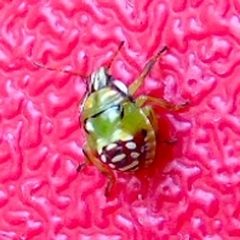
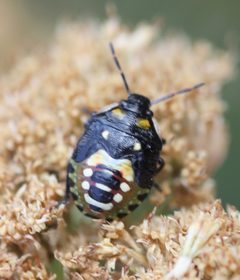
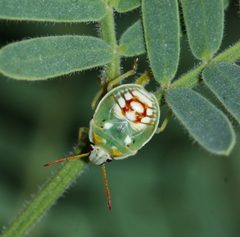
Tylospilus are distinguished from other pentatomid by prominent pointed projections on the pronotum and often the scutellum, giving the body a 'sharp' or angular appearance. The genus is further characterized by predatory mouthparts with a robust, curved adapted for piercing prey. Species-level identification requires examination of male genitalia and subtle differences in pronotal armature; T. acutissimus has exceptionally acute pronotal spines, while T. armatus shows more robust, arm-like projections.
Images
Habitat
occur in a range of terrestrial including forests, scrublands, and agricultural areas where prey insects are abundant. Observations suggest association with vegetation structure that supports of soft-bodied insects.
Distribution
The is distributed in the New World, with records from the southern United States (T. acutissimus), Mexico, Central America, and throughout South America including Chile, Argentina, Brazil, and Peru. Individual show more restricted ranges: T. chilensis is to Chile, T. peruvianus to Peru, and T. armatus to the southwestern United States and Mexico.
Diet
Predatory. Members feed on other insects and related arthropods, using their to consume soft-bodied prey.
Behavior
Predatory hunting has been observed, with individuals actively searching vegetation for prey rather than remaining . Defensive secretion of compounds from the metathoracic occurs when disturbed, as in other pentatomids.
Ecological Role
As , in this contribute to of herbivorous insect in their . Their presence in agricultural systems may provide natural suppression of pest species, though this role has not been formally quantified.
Human Relevance
Limited direct economic impact. Not known as significant agricultural pests due to predatory rather than herbivorous habits. Occasional presence in crops may be beneficial for pest management, though they are not commercially used as biocontrol agents.
Similar Taxa
- PodisusAnother of predatory stink bugs in Pentatomidae with similar body form and ecological role; distinguished by less pronounced pronotal projections and different male genitalia structure.
- StiretrusPredatory pentatomid with spiny appearance; Tylospilus differs in having more elongated, acute rather than rounded or tuberculate projections.
- EuschistusCommon herbivorous frequently confused with predatory forms; distinguished by rounded body contours, lack of prominent pronotal spines, and plant-feeding mouthpart structure.
More Details
Taxonomic History
The was established by Carl Stål in 1870 with Tylospilus acutissimus as the type . The name derives from Greek 'tylos' (callus, knot) and 'spilos' (spot, mark), likely referring to the distinctive raised pointed structures on the body.
Species Diversity
Five are currently recognized: T. acutissimus (southern US, Mexico, Central America), T. armatus (southwestern US, Mexico), T. chilensis (Chile), T. nigrobinotatus (Argentina, Brazil, Paraguay, Uruguay), and T. peruvianus (Peru). The disjunct distribution pattern suggests possible cryptic diversity or historical vicariance events warranting further study.