
Cyphostethus
Fieber, 1860
Species Guides
1- Cyphostethus tristriatus(Juniper Shield Bug)
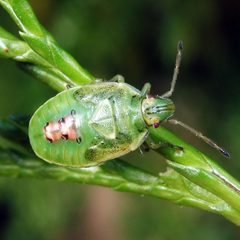
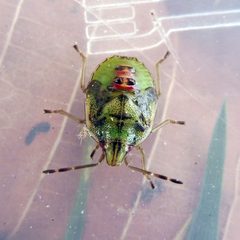
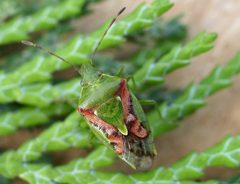
Cyphostethus is a of shield bugs in the Acanthosomatidae. The genus includes six described distributed across Europe and Asia. Cyphostethus tristriatus, the juniper shield bug, is the best-known species and has been introduced to North America. Members of this genus exhibit intraspecific , including melanic morphs.
Pronunciation
How to pronounce Cyphostethus: /sɪˌfoʊˈstiːθəs/
These audio files are automatically generated. While they are not always 100% accurate, they are a good starting point.
Identification
Members of Cyphostethus can be distinguished from other Acanthosomatidae by their distinctive pronotal and scutellar markings. Cyphostethus tristriatus is characterized by three pale longitudinal stripes on a darker background, though highly melanic morphs with reduced or absent striping have been documented. The is separable from similar shield bug genera by the combination of body shape, antennal structure, and male genitalia .
Images
Distribution
Native to the Palearctic region. occur in Europe (including Denmark, Norway, and Sweden), Japan, China, and Turkey. Cyphostethus tristriatus has been introduced to North America, with established documented in the Pacific Northwest of the United States and Canada.
Human Relevance
Cyphostethus tristriatus, the juniper shield bug, is an occasional pest of juniper . The has been introduced to North America, where it represents a potential economic concern for ornamental juniper and cedar plantings.
Similar Taxa
- ElasmostethusBoth belong to Acanthosomatidae and share similar shield-shaped body plans, but Elasmostethus typically lack the distinct longitudinal striping pattern characteristic of Cyphostethus tristriatus and related species.
- AcanthosomaAnother in the same with overlapping distribution; Acanthosoma generally have more pronounced spines on the pronotum and different coloration patterns that distinguish them from Cyphostethus.
More Details
Melanism
A highly melanic morph of Cyphostethus tristriatus was first documented in 2020, representing intraspecific in pigmentation. This dark variant lacks the typical pale longitudinal stripes and appears almost uniformly black.
Taxonomic history
The was established by Fieber in 1860. Six are currently recognized: C. japonicus (Japan), C. ministristriatus (Turkey), C. pallidus (Turkey), C. sinensis (China), C. tristriatus (Europe, introduced to North America), and C. yunnanensis (China).
Sources and further reading
- BugGuide
- Wikipedia
- GBIF taxonomy match
- iNaturalist taxon
- NCBI Taxonomy
- Catalogue of Life
- First record of a highly melanic morph of Cyphostethus tristriatus (Fabricius, 1787) (Hemiptera: Heteroptera: Acanthosomatidae)
- First records of the juniper shield bug,Cyphostethus tristriatus(Fabricius, 1787) (Hemiptera: Acanthosomatidae), in North America