
Oedancala dorsalis
Say, 1831
Oedancala dorsalis is a true in the Pachygronthidae, within the superfamily Lygaeoidea. The was originally described as Pamera dorsalis by Say in 1831. It occurs in North America, with records from the United States and Canada. As a member of the superfamily Lygaeoidea, it belongs to one of the largest and most diverse superfamilies of Heteroptera. The family Pachygronthidae comprises relatively small, often ground-dwelling true bugs.
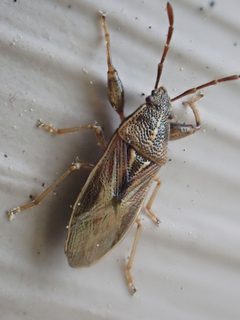
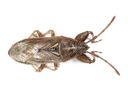

Pronunciation
How to pronounce Oedancala dorsalis: /ɛˈdæŋ.kə.lə dɔrˈsɑː.lɪs/
These audio files are automatically generated. While they are not always 100% accurate, they are a good starting point.
Images
Distribution
Recorded from the United States and Canada. Specific records include Vermont and other North American locations. Distribution data cited from Slater (1964).
More Details
Taxonomic Note
Oedancala dorsalis was originally described as Pamera dorsalis by Thomas Say in 1831. The has been transferred to the Oedancala. Catalogue of Life lists this name as an ambiguous synonym of Oedancala crassimana, though other sources maintain it as a valid species. The basionym Pamera dorsalis is cited in NCBI .
Superfamily Affiliation
This belongs to Lygaeoidea, one of the largest superfamilies of Heteroptera. The superfamily is characterized by diverse feeding habits, though many members are associated with seeds or plant material.
Sources and further reading
- BugGuide
- Wikipedia
- GBIF taxonomy match
- iNaturalist taxon
- NCBI Taxonomy
- Catalogue of Life
- Scorched locust, courtesy of the Locust leafminer, Odontota dorsalis — Bug of the Week
- Scorched locust - Locust leafminer, Odontota dorsalis — Bug of the Week
- Discovery of wasp species previously unknown in the U.S.
- Early Detection, Collaboration Key to Invasive Fruit Fly Eradication in Florida
- How One Entomologist Found Her Calling in Crop Protection