
Metopoplax ditomoides
(Costa, 1847)
Metopoplax ditomoides is a small ground in the Oxycarenidae. It has been documented across Europe, North Africa, the Middle East, and has been introduced to Chile and Canada. The is notable for forming large that migrate from marshy and occasionally invade buildings near riparian zones.

Pronunciation
How to pronounce Metopoplax ditomoides: //ˌmɛtəˈpɒplæks daɪtəˈmɔɪdiːz//
These audio files are automatically generated. While they are not always 100% accurate, they are a good starting point.
Identification
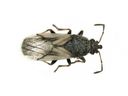
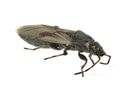
Distinguished from similar ground bugs by the striking contrast between its dark forebody and forewings. The dense punctation and short white hair covering on the , pronotum, and scutellum provide additional diagnostic characters. Similar in Oxycarenidae lack this specific combination of dark forebody with contrasting wings.
Images
Appearance
Small ground with a dark forebody that contrasts sharply with the forewings. The , pronotum, and scutellum are densely punctured and covered with short white hairs.
Habitat
Associated with marshy and riparian environments. Documented in wetlands and areas near water bodies where it forms breeding .
Distribution
Native to Europe, North Africa, and the Middle East: recorded from France, England, Germany, Netherlands, Italy, Portugal, Spain, Switzerland, Belgium, Bosnia, Bulgaria, Luxembourg, Macedonia, Malta, Yugoslavia, Algeria, Morocco, Tunisia, Libya, Czechoslovakia, Hungary, Poland, Russia (Astrakhan, Caucasus), Syria, and Turkey. Introduced to Chile and Canada.
Behavior
Forms large that undertake from marsh . During these migrations, has been observed to invade buildings located near riparian areas in substantial numbers.
Human Relevance
Considered a nuisance pest when large numbers invade buildings near riparian areas during seasonal from marshes. Documented in pest management literature for this .
Similar Taxa
- Other Oxycarenidae speciesSimilar small ground , but distinguished by the specific combination of dark forebody with contrasting forewings and dense punctation with white hairs
More Details
Distribution records
Distribution data compiled from Slater (1964), Péricart (2001), Flores & Riveras (2018), Wheeler & Hoebeke (2012), and Lis & Kadej (2019)