
Heterogaster urticae
(Fabricius, 1775)
nettle ground bug
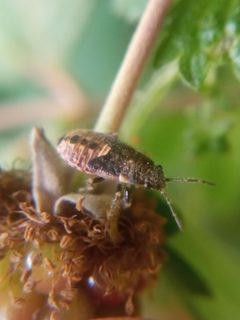
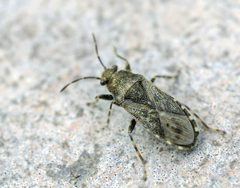
Heterogaster urticae, commonly known as the nettle ground , is a small true bug in the Heterogastridae. measure 6–7 mm in length and are characterized by yellow-brown to brown coloration with distinctive dark and light markings on the legs and connexivum. The is strongly associated with stinging nettles (Urtica dioica) in Europe, where it forms conspicuous . It has a wide distribution across Africa, Europe, Northern Asia (excluding China), New Zealand, and North America.
Pronunciation
How to pronounce Heterogaster urticae: //ˌhɛt.ə.roʊˈɡæs.tər ˌɜrˈtɪˌsiː//
These audio files are automatically generated. While they are not always 100% accurate, they are a good starting point.
Identification
Heterogaster urticae can be distinguished from similar by several morphological features. The body is shiny with yellow-brown to brown pronotum and . The and pronotum are covered with whitish long erect hairs. The fore bear a single spine, and the pale tibiae display three dark annulations. The rostrum reaches only to the middle . These characters separate it from the Nearctic Heterogaster behrensii, which occurs in North America.
Images
Distribution
Africa, Europe, Northern Asia (excluding China), New Zealand, and North America. Within Europe, recorded from Albania, Austria, Belgium, Bulgaria, Czech Republic, Denmark, Finland, France, England, Germany, Greece, Hungary, Ireland, Italy, Poland, Portugal, Romania, Russia, Spain, Sweden, Switzerland, Croatia, Ukraine, and Scotland. Also present in North Africa (Algeria, Egypt, Morocco, Tunisia), Turkey, Iran, Azerbaijan, Japan, Lebanon, Syria, Turkmenistan, and the Azores.
Seasonality
overwinter beneath bark or in hollow woody stems and emerge in spring. Mating occurs in June and July, with pairs remaining coupled for 3–4 days. Larvae are present until September, with the new completing development from late summer onwards.
Host Associations
- Urtica dioica - primary main plant in Europe; form conspicuous on nettles
- Urtica - other of Urtica reported as
- Ammophila arenaria - roots reported as ; Poaceae
Life Cycle
are laid in the ground near the plant with a copious secretion. Larval development occurs through the summer, with larvae present until September. The new is complete from late summer onwards. overwinter in protected locations such as beneath bark or in hollow woody stems.
Behavior
often form conspicuous on nettles. During mating, males and females may remain coupled together for 3–4 days.
Similar Taxa
- Heterogaster behrensiiNearctic distinguished by comparative morphological characters; H. urticae serves as the Palearctic reference for differentiation
Sources and further reading
- BugGuide
- Wikipedia
- GBIF taxonomy match
- iNaturalist taxon
- NCBI Taxonomy
- Catalogue of Life
- Stem- and Leaf- Feeding Insects - AgriLife Extension Entomology
- Mitey troubles for house plants: Twospotted spider mite, Tetranychus urticae — Bug of the Week
- How the Mighty Mite Conquered the Heart of One Entomologist
- How One Entomologist is Breaking Barriers in Crop Protection
- Rice Root Aphid: An Insect Surprise on Indoor-Grown Cannabis
- Provisional checklist of European butterfly larval foodplants
- Heterogaster behrensii (Uhler) (Hemiptera: Lygaeoidea: Heterogastridae): New Distribution Records, Biological Notes, and Characters Distinguishing it from the Palearctic H. urticae (F.)