
Holcocranum saturejae
(Kolenati, 1845)
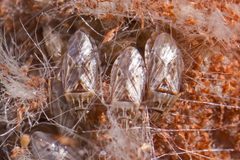
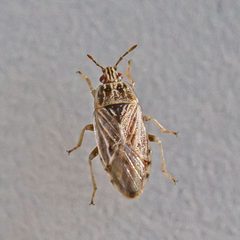
Holcocranum saturejae is a of true in the Artheneidae. It has a broad distribution spanning the Palearctic region, Africa, and North America, with the North American believed to be introduced. The species was first described by Kolenati in 1845. It is one of the more widely recorded members of its .
Pronunciation
How to pronounce Holcocranum saturejae: /hɒlkoʊˈkrænəm sætʃʊˈriːiː/
These audio files are automatically generated. While they are not always 100% accurate, they are a good starting point.
Images
Distribution
Native to Europe, North Africa, the Middle East, Central Asia, and sub-Saharan Africa. Documented in countries including France, Germany, Italy, Spain, Greece, Bulgaria, Hungary, Romania, Russia, Ukraine, Morocco, Algeria, Tunisia, Egypt, Turkey, Syria, Israel, Jordan, Azerbaijan, Kazakhstan, Kyrgyzstan, Turkmenistan, Chad, Ghana, Sudan, Tanzania, and Namibia. Present in North America as an introduced , particularly in the USA. Records span Crimea, the Caucasus, and the former Yugoslavia.
Host Associations
- Satureja - presumed plantSpecific epithet 'saturejae' suggests association with plants of the Satureja (savory), though direct documentation is limited
More Details
Taxonomic history
Originally described by Kolenati in 1845; the Holcocranum remains relatively small and understudied within the Artheneidae.
Distribution data sources
Distribution records compiled from Slater (1964), Péricart (2001), and Deckert (2000), indicating sustained documentation across decades.