
Belostoma flumineum
Say, 1832
giant water bug, toe biter
Belostoma flumineum is a North American giant water bug reaching 2–2.5 cm in length. This aquatic inhabits ponds, wetlands, and marshes with muddy bottoms, where it preys on aquatic including backswimmers, water boatmen, nymphs, and snails. The exhibits exclusive paternal care: females deposit on the male's back, and males carry and oxygenate the eggs for 7–14 days until hatching. Recent studies document significant shifts in reproductive , with northeastern losing their historical fall breeding peak between 2005–2006 and 2012–2015.
Pronunciation
How to pronounce Belostoma flumineum: /bɛloˈstɔma fluˈmɪniəm/
These audio files are automatically generated. While they are not always 100% accurate, they are a good starting point.
Identification
Distinguished from similar giant water bugs by size range and geographic distribution. The forelegs with vice-grip grasping structure and the presence of respiratory appendages (not respiratory siphons) separate Belostoma from Lethocerus, which possesses a terminal respiratory siphon. The combination of flattened swimming legs, dorsoventrally flattened body, and absence of ocelli aids field identification. -level identification requires examination of male genitalia.
Images
Appearance
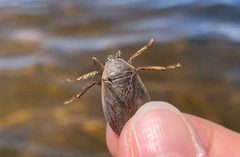
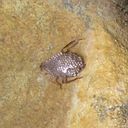
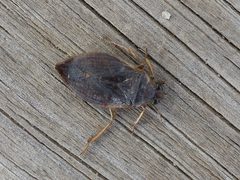
Body ovoid-elongate and dorsoventrally flattened, brown in coloration. Length 2–2.5 cm. Six legs with pair modified as strong appendages for grasping prey. Four legs slightly flattened, adapted for swimming. Mouthparts form a stout syringe-like rostrum with long piercing stylets derived from modified and . Posterior bears retractable strap-like appendages for snorkeling while submerged. Large present; ocelli absent.
Habitat
Freshwater wetlands, marshes, and ponds with muddy bottoms. Occupies vegetated areas among aquatic weeds. Overwinters in pond substrates. Requires access to air-water interface for respiratory purposes.
Distribution
North America, with records from Middle America. Documented in northeastern United States where reproductive studies have been conducted. GBIF records indicate presence in North America and Middle America.
Seasonality
Historically exhibited bimodal breeding with spring mating by overwintered and fall mating by young adults of the new . Recent northeastern (2012–2015) show elimination of fall breeding activity, with restricted to spring.
Diet
Active consuming backswimmers (Notonectidae), water boatmen (Corixidae), nymphs (Odonata), and snails (Gastropoda). Will attack smaller conspecifics though is not regular. Injects digestive saliva to liquefy prey tissue before consumption.
Life Cycle
stage deposited on male's back; incubation 7–14 days. Nymphal development through . Two per year historically, with producing spring offspring that mature to breed in fall. Recent phenological shifts in some have eliminated the fall breeding peak.
Behavior
Males exhibit exclusive paternal care: carry pads on dorsum, perform air at water surface to oxygenate eggs, and engage in pumping and brood stroking to increase water flow over eggs. Males may discard egg pads based on pad size, male age, female presence, and temperature. Exhibits -level lateralized with left-biased turning in T-maze tests. Stalks prey using vegetation cover, ambushes with rapid strike using forelegs.
Ecological Role
Apex in preferred aquatic . K-selected with . pressure on lower including aquatic insects and mollusks. Serves as research model for studies and predator-prey dynamics in freshwater .
Human Relevance
Research subject for studies on paternal care evolution, reproductive trade-offs ( decreases male lifespan), and climate change effects on . Used in pressure experiments assessing tadpole survival in vegetated versus non-vegetated . Bite can be painful but medically insignificant. Occasionally mistaken for kissing bugs (Triatominae) in public health contexts, causing undue alarm.
Similar Taxa
- Lethocerus americanusLarger North American giant water bug with terminal respiratory siphon versus strap-like appendages in Belostoma; different male number (8 vs. 24)
- Benacus griseusAnother North American belostomatid with distinct number (28) and heteropycnosis in
Misconceptions
Giant water bugs including B. flumineum are occasionally subject to sensationalist misinformation, such as false claims that their bites cause trypophobia-triggering skin conditions. The may be confused with kissing bugs (Triatominae) by untrained observers, though B. flumineum is aquatic, lacks capacity, and possesses distinctly different .
More Details
Chromosomal characteristics
Male germ contain 24 spermatogonial with XY pair. Parasynapsis occurs during chromosome pairing.
Research significance
Among the most intensively studied giant water bugs due to accessible paternal care system, making it a model for behavioral and reproductive evolution studies.
Climate change indicator
Documented phenological shifts in northeastern (>30 day reproductive delays and loss of fall breeding peak) make this a potential indicator of climate change effects on aquatic insect .
Sources and further reading
- BugGuide
- Wikipedia
- GBIF taxonomy match
- NCBI Taxonomy
- Catalogue of Life
- Faces in the Crowd at the Bohart Museum Open House | Bug Squad
- Belostomatidae | Beetles In The Bush
- So, how big do insects get? - Buglife Blog - Buglife
- How a giant water bug reached the island of Cyprus
- Uncategorized | Blog - Part 33
- Not a Kissing Bug: Invasive Western Conifer-Seed Bug Causes Undue Alarm
- Reproduction Decreases Life Span in the Giant Waterbug (Belostoma flumineum)
- The population biology of the giant water bug Belostoma flumineum Say (Hemiptera: Belostomatidae)
- Recent changes in reproductive phenology of a K-selected aquatic insect predator, Belostoma flumineum Say (Heteroptera, Belostomatidae)
- Evidence of population-level lateralized behaviour in giant water bugs, Belostoma flumineum Say (Heteroptera: Belostomatidae): T-maze turning is left biased
- Spermatogenesis in the Belostomatidae. II. The chromosomes and cytoplasmic inclusions in the male germ cells of Belostoma flumineum Say, Lethocerus americanus Leidy, and Benacus griseus Say
- Termination of parental care in male giant waterbugs,Belostoma flumineumSay (Heteroptera: Belostomatidae) is associated with breeding season, egg pad size, and presence of females