
Belostoma bakeri
Montandon, 1913
giant water bug
Belostoma bakeri is a giant water bug in the Belostomatidae, described by Montandon in 1913. The is distributed across Central America and North America. Research at Montezuma Well, Arizona has established it as a significant top in fishless desert spring , where it contributes substantially to secondary consumer production and trophic energy flow.
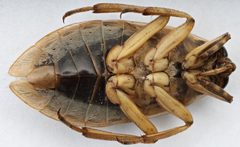
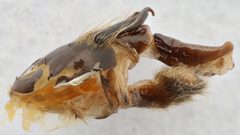
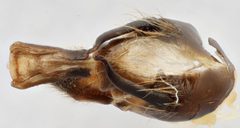
Pronunciation
How to pronounce Belostoma bakeri: /bɛloʊˈstɔmə ˈbeɪkəraɪ/
These audio files are automatically generated. While they are not always 100% accurate, they are a good starting point.
Images
Habitat
Aquatic freshwater environments including fishless desert springs. Documented from Montezuma Well, Arizona—a thermally constant aquatic lacking fish . Likely occurs in ponds, slowly moving freshwaters, and spring systems throughout its range.
Distribution
Central America and North America. Specific records from Montezuma Well, Arizona. GBIF records indicate presence in Middle America and North America.
Diet
Predatory on aquatic . Laboratory studies demonstrate preferential capture of amphipods (Hyalella montezuma) over nymphs (Telebasis salva), with prey movement influencing success. Captures more amphipods (≥3 mm) than juveniles (<3 mm) under light conditions.
Behavior
Predatory is influenced by prey activity levels; more active prey (amphipods) are captured more frequently than less active prey ( nymphs). Visual component suggested by size-selective capture of amphipods in light versus dark conditions.
Ecological Role
Top in fishless aquatic . Production of 2.8 g dry weight m⁻² yr⁻¹, representing 25% of total secondary consumer production and 72% of top predator production at Montezuma Well. Contributes to energy transfer with ecological of 2.7% between lower and aquatic heteropterans.
More Details
Production Ecology
At Montezuma Well, Arizona, Belostoma bakeri exhibited a mean standing stock of 0.214 g m⁻², annual P:B̄ ratio of 13.3, cohort P:B̄ of 4.7, and annual energy production of 5.88 × 10⁴ J m⁻² yr⁻¹.
Trophic Position
Ecological in the Montezuma Well was measured at 13.2% between primary producers and amphipods, 5.1% between amphipods and nymphs, and 2.7% between lower levels and aquatic heteropterans including B. bakeri.
Sources and further reading
- BugGuide
- Wikipedia
- GBIF taxonomy match
- iNaturalist taxon
- Catalogue of Life
- Bembicid Holdings | Entomology Research Museum
- Faces in the Crowd at the Bohart Museum Open House | Bug Squad
- Belostomatidae | Beetles In The Bush
- So, how big do insects get? - Buglife Blog - Buglife
- How a giant water bug reached the island of Cyprus
- Pensoft Editorial Team | Blog - Part 138
- Role of Belostoma bakeri (Heteroptera) in the trophic ecology of a fishless desert spring