
Mesovelia mulsanti
White, 1879
Mulsant's water treader
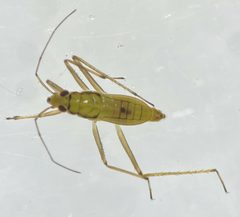
Mesovelia mulsanti, known as Mulsant's , is a small semiaquatic true in the Mesoveliidae. measure 3–4 mm and inhabit freshwater environments with floating vegetation. The has a broad distribution across the Americas and Hawaii. It is a surface-dwelling that feeds on small trapped at the water surface film.
Pronunciation
How to pronounce Mesovelia mulsanti: /mɛsəˈviːliə mʌlˈsanti/
These audio files are automatically generated. While they are not always 100% accurate, they are a good starting point.
Identification
M. mulsanti can be distinguished from other Mesovelia by geographic range and subtle morphological characters, though specific diagnostic features require examination. It is the most common North American species in its . Accurate identification to species level typically requires examination of genitalic structures or reference to regional keys.
Images
Appearance
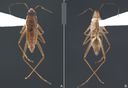
are 3–4 mm in length. As a member of Mesoveliidae, the body is elongate and slender, adapted for moving on the water surface film. The legs are long and slender, with the middle and hind pairs modified for skating on water.
Habitat
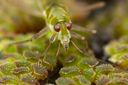
Inhabits standing freshwater environments with abundant floating vegetation, particularly duckweed (Lemna spp.) and . Occurs in both shaded and unshaded areas. Found in ponds, marshes, and other lentic where surface film is present.
Distribution
Native to the Americas with introduced in Hawaii. Main range extends from southern Canada to Texas. Also occurs in Central America, South America, and the Caribbean. Distribution records indicate presence across North America, Middle America, South America, Caribbean, and Oceania (Hawaii).
Seasonality
In temperate regions (e.g., southern Illinois), active from mid-April through November. First instars appear mid-April; first emerge early May. No active individuals found after November. In subtropical and tropical regions (e.g., Florida, Caribbean), may be active year-round without winter .
Diet
Surface-dwelling feeding on small , primarily insects, found on or near the water surface. Preys on crustaceans that rise to the surface film.
Life Cycle
Trivoltine in temperate regions, producing three full per year with a potential partial fourth generation in late autumn. Overwinters exclusively as ; nymphs and do not survive freezing conditions. In subtropical and tropical regions, may occur year-round without entering . First instars appear mid-April in temperate zones, with overlapping instars and generations.
Behavior
Skates on the water surface film using middle and hind legs. Active surface that captures prey at the air-water interface.
Ecological Role
of small surface-dwelling in freshwater lentic . Contributes to regulation of of insects and crustaceans at the water surface.
Human Relevance
No documented direct economic or medical significance. Occasionally encountered by aquatic ecologists and entomologists as a common component of freshwater surface .
Similar Taxa
- Other Mesovelia speciesCo-occur in similar ; M. mulsanti is distinguished as the most common North American , with other species having more restricted distributions (e.g., M. amoena and M. furcata known only from Douglas Lake, Michigan region per historical records)
More Details
Population sampling
sampling methods collect more representative of nymphs and than aquatic net collecting, providing more accurate representation of chronology.
Sources and further reading
- BugGuide
- Wikipedia
- GBIF taxonomy match
- iNaturalist taxon
- NCBI Taxonomy
- Catalogue of Life
- Life History of <i>Mesovelia Mulsanti</i> (Hemiptera: Mesoveliidae) in Southern Illinois
- Comparison of Two Population Sampling Methods Used in Field Life History Studies of <i>Mesovelia Mulsanti</i> (Heteroptera: Gerromorpha: Mesoveliidae) in Southern Illinois
- THE BIOLOGY OF THREE NORTH AMERICAN SPECIES OF MESOVELIA (HEMIPTERA-MESOVELIIDAE).,