
Repipta
Stål, 1859
Species Guides
2- Repipta flavicans
- Repipta taurus(Red Bull Assassin)
Repipta is a of assassin bugs (Reduviidae: Harpactorinae) established by Stål in 1859. The genus contains at least 25 , with the majority distributed in the Neotropics and some extending into the Nearctic region. Species in this genus are predatory, with documented showing five nymphal instars and total development from to of approximately 2-3 months under laboratory conditions. Two species, R. flavicans and R. taurus, have been studied in detail regarding their stages and developmental .
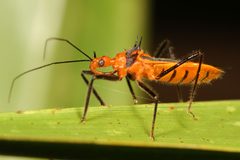
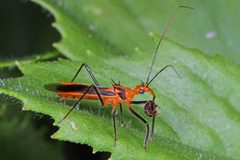
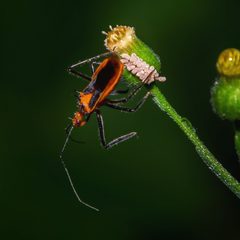
Pronunciation
How to pronounce Repipta: /rɛˈpɪpta/
These audio files are automatically generated. While they are not always 100% accurate, they are a good starting point.
Images
Distribution
Primarily Neotropical, with some extending into the Nearctic region. Specific country-level distributions require examination of the full taxonomic revision.
Diet
Predatory. Specific prey items have not been documented in the available sources.
Life Cycle
hatch after 5-7 days of incubation at 26±2°C. Five nymphal instars occur for both studied (R. flavicans and R. taurus). Nymphal development spans 37-50 days depending on species. First instar lasts 5-6 days; second instar 5-6 days; third instar 7-8 days; fourth instar 9-10 days; fifth instar 10-12 days. Total from egg to is approximately 2-3 months. Adults live 3-4 months under laboratory conditions.
Behavior
First instar nymphs remain near shells after hatching, possibly feeding on egg or remaining . Active predatory is observed from the second instar onward through all nymphal stages and in . Aggressive predatory behavior has been documented in laboratory settings.
More Details
Species diversity
The was revised in 2012, with 13 known redescribed and 12 new species described, bringing the total to at least 25 species. The revision included descriptions of male and female genitalia and a key to species.
Laboratory rearing conditions
studies were conducted at 26±2°C with 70±10% relative humidity and a 14:10 light:dark , though these conditions may not reflect natural field conditions.
Sources and further reading
- BugGuide
- Wikipedia
- GBIF taxonomy match
- iNaturalist taxon
- NCBI Taxonomy
- Catalogue of Life
- IMMATURE STAGES AND LIFE CYCLE OF REPIPTA FLAVICANS STÅL AND R. TAURUS (FABRICIUS) (HETEROPTERA: REDUVIIDAE)
- Revision of genus Repipta Stål 1859 (Hemiptera: Heteroptera: Reduviidae: Harpactorinae) with new species and distribution data