
Apiomerus cazieri
Berniker & Szerlip, 2011
Desert Bee Assassin
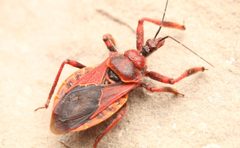
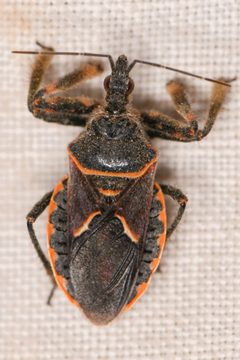
Apiomerus cazieri is a of assassin bug ( Reduviidae) to the Chihuahuan and Sonoran Deserts of the southwestern United States and northern Mexico. The species was described in 2011 and is commonly known as the Desert Assassin. It is an active with documented prey including the checkered beetle Trichodes ornatus and honey bees (Apis mellifera). The species belongs to the Apiomerus, whose members are frequently observed hunting on flowers where they ambush .
Pronunciation
How to pronounce Apiomerus cazieri: /ˌeɪpiˈɒmərəsˌkæziˈɛri/
These audio files are automatically generated. While they are not always 100% accurate, they are a good starting point.
Identification
Apiomerus cazieri can be distinguished from related by its desert distribution and specific prey associations. Within the Apiomerus, it replaces the darker A. crassipes to the east and the more broadly distributed A. spissipes of the Great Plains. The species shows typical Apiomerus with an elongate body, forelegs adapted for grasping prey, and a curved rostrum for piercing. Coloration and exact pattern details require specimen examination for definitive identification; consult Berniker et al. (2011) for diagnostic features separating it from in the crassipes and pictipes species groups.
Images
Habitat
Chihuahuan and Sonoran Desert environments, including desert scrub and arid grasslands. Associated with flowering plants where prey visitation occurs.
Distribution
Southwestern United States (Arizona, New Mexico, Texas) and northern Mexico. Records concentrated in desert regions of these areas.
Diet
Active of Trichodes ornatus (a checkered beetle in Cleridae) and honey bees (Apis mellifera). Hunting strategy involves ambush on flowers where prey come to forage.
Host Associations
- Apis mellifera - prey
- Trichodes ornatus - preycheckered beetle
Behavior
Ambush that hunts on flowers, concealing itself on or beneath blossoms to capture visiting and other insects. Documented to hide under coneflower petals (Echinacea sp.) when hunting.
Ecological Role
in desert , contributing to regulation of and . May influence local dynamics of native bees and associated flower-visiting insects.
Human Relevance
Potential minor impact on in managed located near natural desert . Bite can cause pain and should be avoided; like other reduviids, possesses capable of defensive stabbing.
Similar Taxa
- Apiomerus spissipesBroadly distributed across Great Plains, replaced by A. cazieri in desert Southwest; generally lighter coloration and different distribution
- Apiomerus crassipesOccurs further east, generally darker in coloration; distribution abuts or overlaps with A. cazieri in transitional zones
- Apiomerus flaviventrisAnother desert-dwelling with yellow coloration; found in similar and requires careful examination for separation
More Details
Taxonomic history
Described by Berniker & Szerlip in 2011 as part of a comprehensive revision of the crassipes and pictipes groups of Apiomerus. The species epithet honors an entomologist (presumably Cazier, based on standard practices in the ).
Collection notes
Specimens have been collected at lights and by active searching on flowering vegetation. The appears to be genuinely uncommon in collections, with relatively few Oklahoma specimens available for study as of 2011.