
Leptodictya nicholi
Drake, 1926
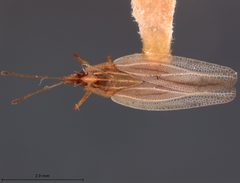
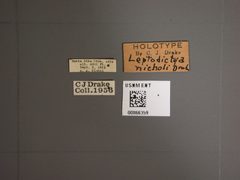
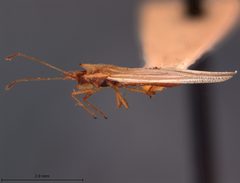
Leptodictya nicholi is a lace bug in the Tingidae, described by Drake in 1926. The belongs to a whose members are associated with monocotyledonous plants, particularly grasses and sedges. Records indicate presence in North America, specifically Arizona. As with other tingids, it likely feeds on plant sap using .
Pronunciation
How to pronounce Leptodictya nicholi: /lɛptoʊˈdɪktɪə ˈnɪkəlaɪ/
These audio files are automatically generated. While they are not always 100% accurate, they are a good starting point.
Identification
Distinguished from other Leptodictya by characters established in Drake's 1926 original description. The Leptodictya is recognized by association with monocots and specific pronotal and hemelytral venation patterns. Exact diagnostic features for L. nicholi require examination of type material or original description.
Images
Appearance
As a member of Tingidae, possesses the -diagnostic reticulate, lace-like pronotum and formed by expanded, flattened areolae. Specific morphological features for L. nicholi include those described in the original by Drake (1926), distinguishing it from .
Habitat
Associated with monocotyledonous plants, particularly grasses (Poaceae) and sedges (Cyperaceae), based on -level . Specific microhabitat preferences for this are not documented.
Distribution
Known from Arizona, United States (ISO code ARIOO in GBIF records). Distribution beyond this type locality is not established in available sources.
Diet
Phloem-feeding on plant sap, inferred from -level ; specific plant records for this are not documented.
Similar Taxa
- Other Leptodictya species share monocot associations and general lace bug ; require examination of pronotal and hemelytral areolation patterns, plus male genitalia, for definitive separation.
- Other Tingidae on monocotsSeveral tingid (e.g., Corythucha, Stephanitis) include on grasses; Leptodictya is distinguished by specific areolation patterns and fidelity to monocots.
More Details
Taxonomic Note
described by Carl J. Drake in 1926. Drake was the foremost on Tingidae in the early 20th century, describing hundreds of species. The original description likely appeared in Proceedings of the Biological Society of Washington or similar venue.
Data Limitations
This is represented by minimal occurrence records in aggregated databases. No subsequent taxonomic revisions, plant studies, or ecological observations have been traced in readily accessible literature. Much of what is presented here is extrapolated from and characteristics.