
Acalypta nyctalis
Drake, 1928
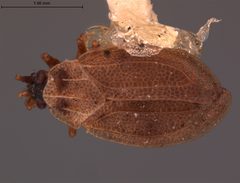
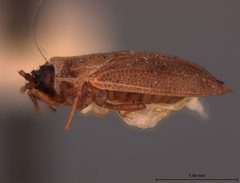
Acalypta nyctalis is a of lace bug in the Tingidae, first described by Drake in 1928. It belongs to the large Acalypta, which contains numerous small, flattened lace bugs. The species is documented from across northern and central North America, with records spanning much of Canada. Like other tingids, it likely feeds on plant sap, though specific associations remain poorly documented.
Pronunciation
How to pronounce Acalypta nyctalis: /əˈkælɪptə nɪkˈteɪlɪs/
These audio files are automatically generated. While they are not always 100% accurate, they are a good starting point.
Identification
Identification to level within Acalypta requires examination of pronotal and hemelytral reticulation patterns, along with male genitalia. Acalypta nyctalis can be distinguished from by specific features of the pronotal hood and areolate structure, though these characters require microscopic examination. The species is small (approximately 2-3 mm), with the characteristic flattened, lace-like appearance of the .
Images
Distribution
North America, with Canadian provincial records from Alberta, British Columbia, Labrador, Manitoba, New Brunswick, Newfoundland, Nova Scotia, Nunavut, Northwest Territories, Ontario, Prince Edward Island, Quebec, Saskatchewan, and Yukon. The distribution suggests a primarily northern and range.
Similar Taxa
- Other Acalypta speciesNumerous occur in overlapping ranges; separation requires detailed examination of pronotal structure, areolation , and male genitalia.
- Other Tingidae generaSimilar flattened, reticulate appearance; Acalypta is distinguished by pronotal hood structure and areolate patterns visible under magnification.
More Details
Taxonomic history
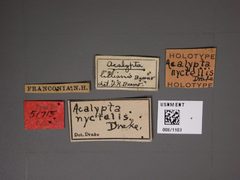
Described by Carl J. Drake in 1928, a prolific on the Tingidae. The epithet 'nyctalis' derives from Greek 'nyx' (night), possibly alluding to coloration or collection circumstances.
Data limitations
This has zero observations in iNaturalist and minimal published biological data. Most information must be inferred from -level characteristics, with species-level essentially undocumented.