
Lygus rugulipennis
Poppius, 1911
European Tarnished Plant Bug
Lygus rugulipennis is a small plant bug in the Miridae, commonly known as the European . It is a widespread pest with an exceptionally broad range, documented on over 400 plant across 57 families. The species is native to the Palaearctic region but has been introduced to North America. It is economically significant as a pest of alfalfa, clover, potato, cereals, sugar beet, and various other crops, causing damage through feeding on plant tissues.

Pronunciation
How to pronounce Lygus rugulipennis: /ˈlaɪɡəs ˌruːɡjʊlɪˈpɛnɪs/
These audio files are automatically generated. While they are not always 100% accurate, they are a good starting point.
Identification
Distinguished from similar Lygus (particularly L. pratensis and L. maritimus) primarily by the dense of the , where the space between hairs is less than the length of one hair. This microscopic character requires examination of the forewing texture. The bristly legs and variable coloration alone are insufficient for definitive identification.
Images
Appearance
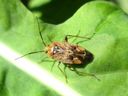
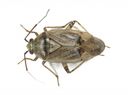
measure 5–6 mm in length. The body is small and oval-shaped. The (part of the forewing) is densely pubescent with fine hairs, with spaces between hairs shorter than the hair length itself. Legs are notably bristly. Wing tips are membranous. Coloration is highly variable, ranging from purple to yellowish-brown, with males typically exhibiting stronger markings than females. Females commonly vary from dark red to light reddish-brown.
Habitat
Occurs in gardens, agricultural fields, and areas with abundant vegetation. Found in conifer nurseries, herbaceous crop fields, and natural vegetation. overwinter in leaf litter.
Distribution
Native to the Palaearctic region including most of Europe, extending eastward through Russia to Siberia, Sakhalin Island, and the Kurile Islands, and south to Italy, Spain, and Macedonia. Introduced to North America, with established in Canada (Alberta, British Columbia, Northwest Territories, Yukon Territory) and the United States (Alaska, California, Colorado, Idaho, Montana, Oregon). Also recorded from Japan (Hokkaido).
Seasonality
are present year-round but are more abundant in late summer. Two per year are typical; the second generation becomes adult in autumn and overwinters, with -laying occurring the following spring.
Diet
herbivore that feeds on plant sap by piercing plant tissues. Documented feeding on in Trifolium, Chenopodium, Rumex, Brassicaceae, Fabaceae, Urticaceae, Asteraceae, as well as potatoes, cereals, and alfalfa.
Host Associations
- Trifolium - clover
- Chenopodium -
- Rumex -
- Brassicaceae - mustard
- Fabaceae - legume
- Urticaceae - nettle
- Asteraceae - sunflower
- Solanum tuberosum - potato
- Poaceae - cereals
- Medicago sativa - alfalfa
- Senecio vulgaris - preferred oviposition common groundsel, highly preferred for oviposition
- Stellaria media - preferred oviposition chickweed, highly preferred for oviposition
- Vicia faba - broad bean, used in behavioral studies
- Matricaria recutita - chamomile
- Pinus sylvestris - pest of seedlingsScots pine, damage to seedlings in nurseries
- Betula pendula - silver birch
Life Cycle
Two per year under typical conditions. The second generation becomes in autumn and overwinters in the adult stage. -laying occurs the following spring. Females examine plant substrate with their labial tip, probe tissue with stylets, and insert the ovipositor at the probed point to lay eggs. Nymphs develop through five instars.
Behavior
Females exhibit selective oviposition , preferentially laying in wounded plant tissues over healthy tissues, with preference varying temporally after wounding (1h, 6h, 12h, 24h, 48h). Both sexes use vibratory percussion signals for intraspecific communication, particularly during courtship; signals are substrate-dependent with plant tissues filtering high frequencies. and nymphs are attracted to succulent growth. Movement behavior varies with plant nitrogen content and quality. Uses olfactory and visual cues for host location, responding to volatiles from healthy plants and plant-insect complexes.
Ecological Role
Herbivore with extremely broad range, among the most insects documented. Serves as host for in the Peristenus (Braconidae), with rates of 25–49% reported in Europe. Acts as a pioneer on host plants, with presence influencing subsequent through volatile cues.
Human Relevance
Major agricultural pest causing significant damage to crops. Feeding causes deformed fruit, dirty bloom, shedding of squares and small bolls, stunted growth, and sunken on developing bolls in cotton. Damage recorded on alfalfa, clover, potato, cereals, sugar beet, and various other crops. Considered very harmful due to broad range and economic impact. Subject to programs and control, though resistance development is a concern.
Similar Taxa
- Lygus pratensisSimilar in general appearance and historically confused; distinguished by (L. rugulipennis has denser pubescence with inter-hair spaces less than hair length)
- Lygus maritimusSimilar in general appearance; distinguished by characteristics requiring microscopic examination
- Lygus lineolarisNorth American , morphologically similar but geographically separated; L. lineolaris is confined to North America while L. rugulipennis is primarily Palaearctic with introduced North American
Misconceptions
Historically confused with Lygus pratensis under the broad concept of that ; early biological and pest records attributed to L. pratensis in the Palaearctic region likely refer primarily to L. rugulipennis, which is the more important pest in this region.
More Details
Communication
First in its studied for vibratory communication; males and females emit percussion signals with similar characteristics ( frequency, pulse duration, repetition time, pulses per group)
Parasitoid interactions
European Peristenus digoneutis and P. relictus are being considered for release in North America as agents; levels vary by ecoregion but not significantly by plant within regions
Oviposition mechanism
associated with the stylets are involved in oviposition site location, while uniporous on the tip (11–12 present) function in assessing substrate suitability as a food source
Sources and further reading
- BugGuide
- Wikipedia
- GBIF taxonomy match
- iNaturalist taxon
- NCBI Taxonomy
- Catalogue of Life
- Occasional Pests - AgriLife Extension Entomology
- What You Should Know about 'Berries Vs. Bugs' | Bug Squad
- High Honor for Emily Bick: ESA Student Certification Award | Bug Squad
- Don't Miss This UC Davis Seminar by Ecology Researcher Andrew Corbett | Bug Squad
- Remembering Vernon Burton: 1924-2015 | Bug Squad
- Meloidae Holdings | Entomology Research Museum
- Percussion signals of Lygus rugulipennis Poppius (Heteroptera: Miridae)
- Oviposition Behaviour of Lygus rugulipennis and its Preferences for Plant Wounds
- Oviposition behaviour in Lygus rugulipennis: a morpho‐functional study
- The biology of Lygus rugulipennis Poppius (Hemiptera: Miridae) in Scotland
- Influence of different diets and oviposition substrates on Lygus rugulipennis biology (Heteroptera: Miridae)
- Within species variation in host plant quality and movement behavior of Lygus rugulipennis nymphs
- Host plants of the European tarnished plant bug Lygus rugulipennis Poppius (Het., Miridae)
- Does host plant influence parasitism and parasitoid species composition inLygus rugulipennis? A molecular approach
- The Nomenclature and Life-cycle of the European Tarnished Plant Bug,Lygus rugulipennisPoppius (Hem., Miridae)
- The Use of Olfactory and Visual Cues in Host Choice by the Capsid Bugs Lygus rugulipennis Poppius and Liocoris tripustulatus Fabricius
- Host Plant Influence on Movement Patterns and Subsequent Distribution of the Polyphagous HerbivoreLygus rugulipennis(Heteroptera: Miridae)
- Host plant preference of the tarnished plant bug Lygus rugulipennis Popp. (Het., Miridae)
- Role of the plant–conspecific complex in host location and intra‐specific communication of Lygus rugulipennis
- Effect of temperature on biology and life table parameters of the European tarnished plant bug, Lygus rugulipennis (Hemiptera: Miridae)
- Within species variation in host plant quality and movement behavior of Lygus rugulipennis nymphs