
Koebeliini
Tribe Guides
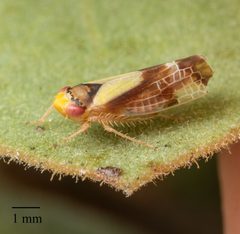
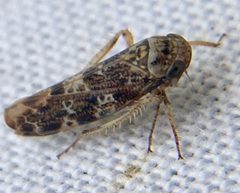
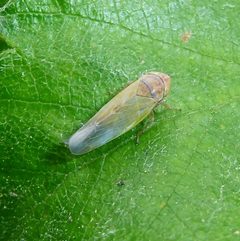
2Koebeliini is a subtribe of leafhoppers within the tribe Athysanini and Deltocephalinae. It comprises six and over 15 distributed across western North America and parts of the Palearctic and Oriental regions. Members of the subtribe Grypotina within Koebeliini exhibit distinctive morphological features including crown striations, short , and ocelli positioned below the crown margin. Several species are associated with pine trees (Pinus spp.) as plants.
Pronunciation
How to pronounce Koebeliini: /koʊˌbɛliˈaɪnaɪ/
These audio files are automatically generated. While they are not always 100% accurate, they are a good starting point.
Identification
Members of subtribe Grypotina can be distinguished by: crown with transverse striations along the margin; short, less than 1.5× length; ocelli positioned below the anterior margin of the crown, not visible from above and distant from the ; narrow anteclypeus extending beyond the anterior margin of the gena; and metatarsomere I with platellae on the plantar surface.
Images
Habitat
High altitude mountainous regions, specifically at elevations above 1700 m in the Himalayan region including the southeastern margin of the Qinghai-Tibet Plateau, Gaoligong Mountains, and the intersection of the Yunnan-Guizhou Plateau and Hengduan Mountains.
Distribution
Western North America ( for some ); Palearctic, Oriental, and Nearctic regions more broadly. Documented from China (Hunan, Hong Kong, Yunnan), Pakistan, India, and Nepal.
Diet
Phloem-feeding on pine trees (Pinus spp., Pinaceae).
Host Associations
- Pinus spp. - plantPinaceae
Behavior
Phototactic has been observed in Pinopona , with individuals collected using light traps.
Ecological Role
Pine leafhoppers feeding on Pinus ; potential role in pine forest and as possible for plant .
More Details
Taxonomic note
Koebeliini has been reclassified as subtribe Koebeliina within tribe Athysanini, though the name Koebeliini persists in literature. The subtribe Grypotina is sometimes treated as part of Koebeliini/Koebeliina.