
Callibaetis floridanus
Banks, 1900
small minnow mayfly
Callibaetis floridanus is a small minnow mayfly (Ephemeroptera: Baetidae) native to North and Central America. The inhabits diverse aquatic environments including coastal ponds subject to saltwater intrusion and temporary wetlands (playas) in arid regions. Research demonstrates significant physiological plasticity in ion regulation, with capable of acclimating to salinities ranging from 113 to 9,921 µS/cm. Naiad development averages approximately 24 days from hatch to adulthood.
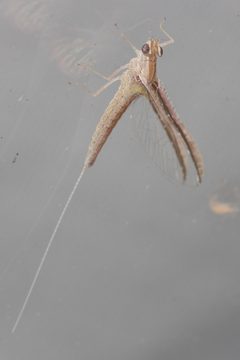
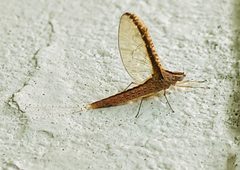
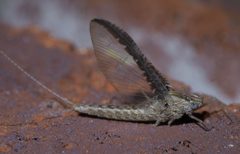
Pronunciation
How to pronounce Callibaetis floridanus: /ˌkælɪˈbeɪtɪs flɔrɪˈdænəs/
These audio files are automatically generated. While they are not always 100% accurate, they are a good starting point.
Images
Habitat
Coastal ponds experiencing routine saltwater intrusion; temporary wetlands (playas) in arid regions such as the Southern High Plains of Texas. The has been documented in aquatic systems with salinity ranging from 113 to 9,921 µS/cm.
Distribution
Central America; North America including Mexico, the southern United States, and the northeastern United States. Specific studied include coastal ponds subject to sea level rise effects and West Texas playas.
Life Cycle
Naiad development time averages 24±0.3 days from hatch to adulthood. Survival rates of 80±4.4% have been documented across experimental salinity treatments. No significant change in development time was observed across salinity gradients from 113 to 9,921 µS/cm.
Behavior
Naiads exhibit physiological plasticity in ion regulation, with acclimation history strongly influencing Na, SO4, and Ca uptake rates. Individuals reared in low salinity (113 µS/cm) showed 10.8-fold higher Na uptake rates than those reared in high salinity (9,921 µS/cm) when transferred to dilute conditions. Conversely, saline-acclimated naiads exhibited reduced ion uptake when exposed to ion-rich water.
Sources and further reading
- BugGuide
- Wikipedia
- GBIF taxonomy match
- iNaturalist taxon
- NCBI Taxonomy
- Catalogue of Life
- Bugs in Orange and Black, Part II: A spooky southern predator heads north in a warming world – Florida predatory stink bug, Euthyrhynchus floridanus — Bug of the Week
- Northern hospitality for the Florida predatory stink bug, Euthyrhynchus floridanus, and wax scales, Ceroplastes spp. — Bug of the Week
- Bug Eric: The Mayfly Analogy
- Amped-Up Ants: Caterpillars' Sugary Treats Earn Carpenter Ant Care
- Bug Eric: Spider Sunday: Funnel-web Wolf Spiders
- Cimbicidae | Beetles In The Bush
- The Biology of Callibaetis floridanus Banks (Ephemeroptera: Baetidae)
- Callibaetis Floridanus (Ephemeroptera: Baetidae) Life History and Production in a West Texas Playa
- Physiological and life history responses in a mayfly (Callibaetis floridanus) inhabiting ponds with saltwater intrusion