
Baetis bicaudatus
Dodds, 1923
small minnow mayfly
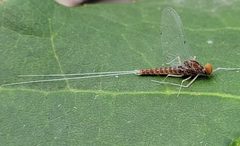
Baetis bicaudatus is a small minnow mayfly in the Baetidae, described by Dodds in 1923. It inhabits streams across western North America from Alaska to the southwestern United States and northern Canada. The is , producing two annually, with distinct summer and winter generations that differ in size and susceptibility to . exhibit characteristic including swarming mating , while nymphs are important grazers on periphyton in stream .
Pronunciation
How to pronounce Baetis bicaudatus: /ˈbaɪtɪs ˌbaɪ.kɔˈduː.təs/
These audio files are automatically generated. While they are not always 100% accurate, they are a good starting point.
Identification
A small in the Baetidae ; specific diagnostic features distinguishing it from are not documented in available sources. As with other Baetis , typically have two tail filaments (the species epithet 'bicaudatus' refers to this), reduced hindwings, and forewings with relatively simple venation. Nymphs possess streamlined bodies adapted for clinging in flowing water, with gills located on the .
Images
Habitat
Small streams and rivers; nymphs occupy areas with varying periphyton abundance on substrates and show patterns influenced by food resource availability. swarming occurs 1-4 meters above ground near spruce trees at meadow edges.
Distribution
Western North America including Alaska, western United States, southwestern Canada, and northern Canada. Specific records from the Rocky Mountain region including the Rocky Mountain Biological Laboratory area in Colorado.
Seasonality
with two per year: a summer generation and a winter generation. and swarming occurs in early morning for 1.5-2 hours. Marked males have been observed returning to swarms 1, 2, or 3 days after marking.
Diet
Nymphs feed on periphyton (attached ).
Host Associations
- Gasteromermis sp. - Mermithid that infects nymphs; causes mortality through failed development or complete sterility in surviving ; levels vary seasonally (1-71%) and spatially with downstream decline; higher in summer
Life Cycle
with two annually. Nymphs develop through multiple instars; late-instar nymphs emerge as subimagos before final to . Infected nymphs show extended development time and reduced size. are short-lived; males may participate in swarming on multiple days.
Behavior
Nymphs exhibit drift in streams; parasitized late-instar nymphs drift less frequently, drift higher in the water column, and swim more frequently while drifting compared to unparasitized individuals. males form mating swarms ranging from few to hundreds of individuals; females flying near swarms are grabbed by males and pairs drop to vegetation to mate. Males show swarm fidelity, returning to the same swarming locations on subsequent days. No size-assortative mating observed; copulating males show less size variability than non-mating males, suggesting stabilizing selection for intermediate male body size.
Ecological Role
Primary consumer and grazer in stream , linking periphyton production to higher . Serves as for parasitic ; effectively divided into unparasitized individuals (where drift affects ) and parasitized individuals (where drift behavior affects survival and fecundity). Important prey item for drift-feeding trout and other aquatic .
Similar Taxa
- Baetis fuscatusBoth are small minnow mayflies in the Baetis with similar general ; B. fuscatus is noted in ecological studies alongside B. bicaudatus but distinguished by subtle morphological features not detailed in available sources
- Other Baetis species share characteristics of small size, two tail filaments, and reduced hindwings; precise identification requires examination of genitalia and wing venation patterns not described here
Sources and further reading
- BugGuide
- Wikipedia
- GBIF taxonomy match
- iNaturalist taxon
- NCBI Taxonomy
- Catalogue of Life
- Dyddiaduron pryf y cerrig ~ blog rhan 2 - Buglife Blog - Buglife
- The Stonefly Diaries ~ a blog Part 2 - Buglife Blog - Buglife
- The Influence of Periphyton Abundance on Baetis bicaudatus Distribution and Colonization in a Small Stream
- Swarming and mating behavior of a mayfly Baetis bicaudatus suggest stabilizing selection for male body size
- The infection of nymphal Baetis bicaudatus by the mermithid nematode Gasteromermis sp.
- The effect of the mermithid parasite Gasteromermis sp. (Nematoda: Mermithidae) on the drift behaviour of its mayfly host, Baetis bicaudatus (Ephemeroptera: Baetidae): a trade-off between avoiding predators and locating food