
Tanyptera
Latreille, 1804
Species Guides
1- Tanyptera dorsalis(Antlered Crane Fly)
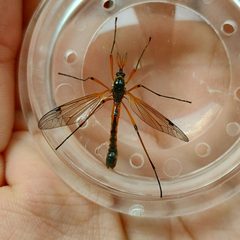
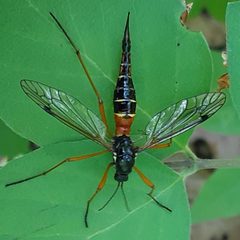
Tanyptera is a of true crane flies distinguished by lustrous black and yellow or red coloration, extreme in size and color, and distinctive antennal . Males possess flagellar segments with three outgrowths (two paired lower, one unpaired upper), while females have distinctly 13-segmented . The genus occurs in deciduous and mixed forests across Europe and Asia, with larvae developing in dead but still hard wood.

Pronunciation
How to pronounce Tanyptera: /tænɪˈptɛrə/
These audio files are automatically generated. While they are not always 100% accurate, they are a good starting point.
Identification
Distinguished from other crane flies by: male flagellar segments with three outgrowths per segment (diagnostic); female 13-segmented ; glabrous mesothoracic sides; unusually long female ovipositor. Resembles some Ichneumonidae ( ) in general appearance but distinguished by dipteran features (single pair of wings, ).
Images
Appearance
Lustrous, metallic body with black and yellow or red coloration. Wings vary from smoky-black, brown, brownish-yellow, to transparent. Females possess an unusually long ovipositor with valves slightly shorter than the . Sides of glabrous (hairless).
Habitat
Deciduous and mixed forests. Larval microhabitat: dead but still hard wood (not decayed soft wood).
Distribution
Europe and Asia. Documented from Denmark, Norway, Sweden, and United States (Vermont, Michigan).
Life Cycle
Larvae develop in dead but still hard wood.
Ecological Role
Larvae contribute to wood decomposition in forest . Minor pest status in Russia where occasionally harmful to forest products.
Human Relevance
Minor pest in Russia, sometimes damaging to forest products. Otherwise limited direct interaction with humans.
Similar Taxa
- IchneumonidaeGeneral resemblance in coloration and body form; distinguished by Tanyptera having only one pair of wings (Diptera) versus two pairs in (Hymenoptera), plus presence of .
- Other TipulidaeTanyptera distinguished by male antennal outgrowths, female 13-segmented , glabrous , and long ovipositor.
More Details
Subgeneric classification
Two subgenera recognized: Mesodictenidia Matsumura, 1931 and Tanyptera Latreille, 1804.