
Limnophila macrocera
(Say, 1823)
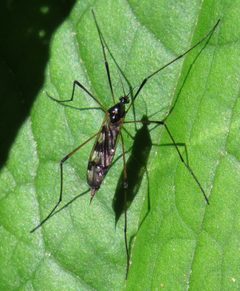
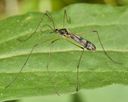
Limnophila macrocera is a of limoniid crane fly in the Limoniidae. It is a small, delicate dipteran with notably elongated . The species is found in moist across eastern North America.
Pronunciation
How to pronounce Limnophila macrocera: /lɪmˈnɒfɪlə ˌmækroʊˈsɪərə/
These audio files are automatically generated. While they are not always 100% accurate, they are a good starting point.
Identification
Distinguished from other Limnophila and limoniid crane flies primarily by the exceptional length of the , which extend well beyond the body. The combination of long antennae, slender build, and wing venation pattern separates it from similar such as Erioptera and Rhipidia. Examination of genitalia may be required for definitive identification.
Images
Appearance
Small to medium-sized crane fly with a slender, delicate body. The most distinctive feature is the extremely long , which are notably longer than those of most related —this is reflected in the species epithet "macrocera" (meaning "large-horned" or "long-antennaed"). Wings are narrow and elongate with reduced venation typical of the . Body coloration is generally pale to brownish.
Habitat
Moist environments including wetlands, marshes, stream margins, and damp woodlands. Larvae develop in saturated soils, mud, or shallow aquatic with abundant organic matter.
Distribution
Eastern Nearctic region. Documented from Canada (Ontario, Quebec, Nova Scotia) south through the United States to Florida, west to Illinois and Tennessee.
Seasonality
have been observed from spring through early autumn, with peak activity likely in late spring to summer.
Life Cycle
Complete with aquatic or semi-aquatic larval stages. Larvae are presumed to feed on decaying organic matter in moist substrates. Specific details of and larval development are not well documented.
Behavior
are weak fliers and are often observed resting on vegetation near larval . Like other crane flies, they are primarily or in activity.
Ecological Role
Larvae contribute to decomposition and nutrient cycling in wetland and riparian . may serve as prey for various .
Human Relevance
No direct economic or medical significance. Occasionally encountered by entomologists and naturalists in wetland surveys.
Similar Taxa
- Limnophila other speciesDistinguished by the exceptional length of in L. macrocera; other in the have proportionally shorter antennae
- Erioptera speciesErioptera generally have shorter and different wing venation patterns
- Rhipidia speciesRhipidia have distinct wing markings and shorter
More Details
Etymology
The specific epithet "macrocera" derives from Greek "makros" (long/large) and "keras" (horn), referring to the conspicuously elongated .