
Ormosia
Jacks., 1811
Ormosias, horse-eye beans, chocho
Species Guides
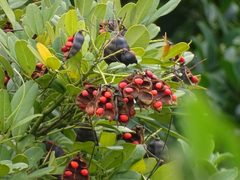
1Ormosia is a of woody legumes (Fabaceae) comprising approximately 130 of trees and large shrubs distributed across tropical regions of the Americas, Asia, and New Guinea. The genus is characterized by distinctive, often brightly colored seeds with decorative patterns that resemble —commonly called "horse-eye beans"—which are poisonous if ingested but valued for ornamental use. Several species are threatened by destruction, with Ormosia howii likely extinct. The genus forms nitrogen-fixing root nodules with rhizobia and exhibits strong adaptability to nutrient-poor soils.
Pronunciation
How to pronounce Ormosia: /ɔrˈmoʊs.i.ə/
These audio files are automatically generated. While they are not always 100% accurate, they are a good starting point.
Images
Habitat
Tropical and subtropical forests, with some extending into temperate regions of East Asia. Native frequently characterized by nutrient-poor soils, including areas with high nitrogen loss, phosphorus deficiency, and low potassium availability. Species such as Ormosia hosiei occur in mixed forests with co-occurring conifers including Pinus massoniana and Cunninghamia lanceolata. Ormosia microphylla is concentrated in mountainous regions of southern China.
Distribution
Native to tropical Americas from southwestern Mexico to Bolivia and southern Brazil; southern, southeastern, and eastern Asia; New Guinea; and Queensland, Australia. Ormosia hosiei is to China, documented in 18 townships across Sichuan, Guizhou, and Fujian provinces. Ormosia henryi is endemic to China. Ormosia microphylla occurs in Fujian, Guangdong, Guangxi, and Guizhou provinces of China.
Diet
Autotrophic via . Enhanced nutrient acquisition through symbiotic nitrogen fixation with rhizobia, particularly Rhizobium tropici strain LNP6 in Ormosia hosiei. Phosphate-solubilizing rhizobia enable access to insoluble phosphorus sources through microbial production of organic acids and phosphatases.
Life Cycle
Seeds of Ormosia hosiei average 14.31 ± 1.43 mm length and 12.54 ± 1.89 mm width, with thousand-seed weight of 898.64 ± 6.3 g; require surface disinfection and 25-day stratification at 28°C for germination. Ormosia henryi exhibits slow growth rate, low natural seed set, and germination difficulties attributed to hard seed coats. Root nodules form upon inoculation with compatible rhizobia; nine-month with repeated inoculations at 30-day intervals establishes stable .
Behavior
Exhibits strong adaptability to low nitrogen and phosphorus availability without significant growth inhibition. Root nodules senesce and release bacterial that persist as free-living phosphate-solubilizing in the rhizosphere. Seeds float and are occasionally found as sea beans.
Ecological Role
Timber resource with potential for nitrogen and phosphorus-efficient forestry. Symbiotic relationships with dual-functional rhizobia contribute to soil nutrient cycling through nitrogen fixation and phosphorus solubilization, potentially reducing phosphorus requirements in plantation settings. Ormosia henryi has ecological value for restoration applications.
Human Relevance
Seeds of Ormosia coccinea and related used for jewelry, decorative purposes, and good luck charms. Wood utilized as timber and firewood. Ormosia nobilis and other species used in folk medicine. Ormosia henryi wood valued for distinctive fragrance, dense texture, and high hardness for furniture and handicrafts; listed as National Class II Protected Wild Plant in China due to endangerment from illegal logging and over-exploitation. of O. henryi sequenced to enable molecular breeding and conservation strategies.
Similar Taxa
- AbrusSeeds resemble those of Ormosia but are smaller; Abrus seeds are also poisonous and used ornamentally
- RhynchosiaSnoutbeans produce seeds similar in appearance to Ormosia but smaller in size
- AdenantheraProduces seeds resembling Ormosia in decorative patterning and ornamental use
Sources and further reading
- BugGuide
- Wikipedia
- iNaturalist taxon
- NCBI Taxonomy
- Catalogue of Life
- Future application potential of Ormosia plant shown by chromosome-level genome of the rare Ormosia henryi
- Simulation of Potential Geographical Distribution and Migration Pattern with Climate Change of Ormosia microphylla Merr. & H. Y. Chen
- The phosphate-solubilizing capacity of Rhizobium tropici LNP6 and its growth-promoting effects on Ormosia hosiei seedlings.